There is no single good profit margin. It depends on your trade, so judge your margins against your own past months and against businesses like yours. Gross margin is sales minus direct costs, divided by sales. Net profit margin is what is left after all costs, including interest and tax, divided by sales. A high gross margin can still leave a thin net margin. Check both every month. This page is general information, not personal advice.
The route, stop by stop
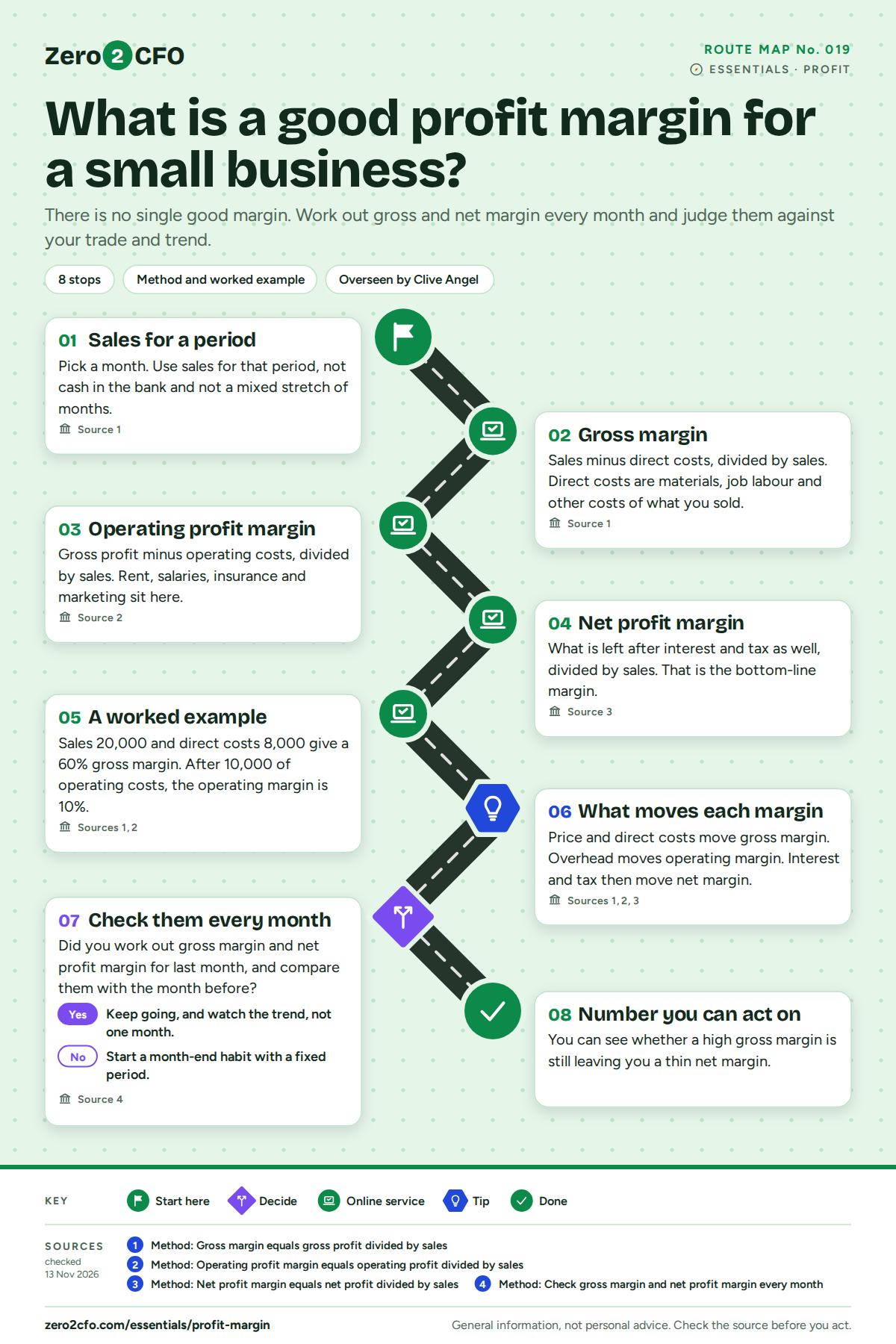
01Sales for a period
Pick a month. Use sales for that period, not cash in the bank and not a mixed stretch of months.
Source 1
02Gross margin
Sales minus direct costs, divided by sales. Direct costs are materials, job labour and other costs of what you sold.
Source 1
03Operating profit margin
Gross profit minus operating costs, divided by sales. Rent, salaries, insurance and marketing sit here.
Source 2
04Net profit margin
What is left after interest and tax as well, divided by sales. That is the bottom-line margin.
Source 3
07Check them every month
Did you work out gross margin and net profit margin for last month, and compare them with the month before?
YesKeep going, and watch the trend, not one month.NoStart a month-end habit with a fixed period.Source 4
08Number you can act on
You can see whether a high gross margin is still leaving you a thin net margin.
The three margins
Gross profit is sales minus direct costs, the costs of what you sold, such as materials, job labour and shipping of the product. Gross margin is gross profit divided by sales.
Operating profit is gross profit minus operating costs, such as rent, salaries, insurance and marketing. Operating profit margin is operating profit divided by sales.
Net profit is what is left after interest and tax as well. Net profit margin is net profit divided by sales. If interest and tax are small, operating margin and net margin will be close. They are still not the same figure.
Worked example
In pounds, for one month: sales £20,000, direct costs £8,000, gross profit £12,000. Gross margin is £12,000 ÷ £20,000 = 60%. Operating costs £10,000 leave operating profit of £2,000. Operating margin is £2,000 ÷ £20,000 = 10%. Interest and tax of £400 leave net profit of £1,600. Net margin is £1,600 ÷ £20,000 = 8%.
In dollars: sales $20,000, direct costs $8,000, gross profit $12,000, and the same steps to a 60% gross margin, a 10% operating margin and an 8% net margin. These are the same figures, not a conversion from one currency to the other.
What moves each margin
Price, mix and direct costs move gross margin. If suppliers put prices up and you do not, gross margin falls. Operating costs move operating margin: a rent rise or extra hire can leave gross margin unchanged and still cut what you keep. Interest and tax then move net margin.
What good looks like
There is no single good profit margin for every small business. It depends on the trade. Compare your margins with businesses like yours, not with a business in a different trade, and watch whether your own figures are rising or falling. The figures in the worked example can be solid in one trade and tight in another. Check both every month, with the same period each time.
Common questions
Is gross margin the same as net profit margin?
No. Gross margin is after direct costs only. Net profit margin is after all costs, including interest and tax. You can have a high gross margin and a thin net margin.
What is the difference between operating margin and net margin?
Operating profit is before interest and tax. Net profit is after them. If those items are small, the two percentages will be close, but they are not the same.
Is a good margin the same in every trade?
No. Compare with businesses like yours, and watch your own trend month by month.
Is this the same as cash in the bank?
No. It is a profit measure for a period. Cash timing still needs a cash forecast.
Is this personal advice?
No. It is general information, a worked method checked on 13 November 2026. Use your own figures.
Where this map sits
EssentialsKnow your numbers
The handful of figures that tell you how the business is really doing.
Where the rules and methods come from
- How it's worked out: Gross margin equals gross profit divided by sales
Worked example: Sales 20,000, direct costs 8,000, in pounds or dollars. Gross profit is 12,000. Gross margin is 12,000 ÷ 20,000 = 60%. - How it's worked out: Operating profit margin equals operating profit divided by sales
Worked example: Gross profit 12,000 minus operating costs 10,000 is 2,000. Operating margin is 2,000 ÷ 20,000 = 10%. - How it's worked out: Net profit margin equals net profit divided by sales
Worked example: After interest and tax of 400, net profit is 1,600. Net margin is 1,600 ÷ 20,000 = 8%. - How it's worked out: Check gross margin and net profit margin every month
Worked example: Use the same period each time. Compare this month with last month, and with the same month last year if you have it.
This map is general information, not personal advice. Rules and rates change, so check the sources before you act. If your situation is tricky, talk to your accountant.