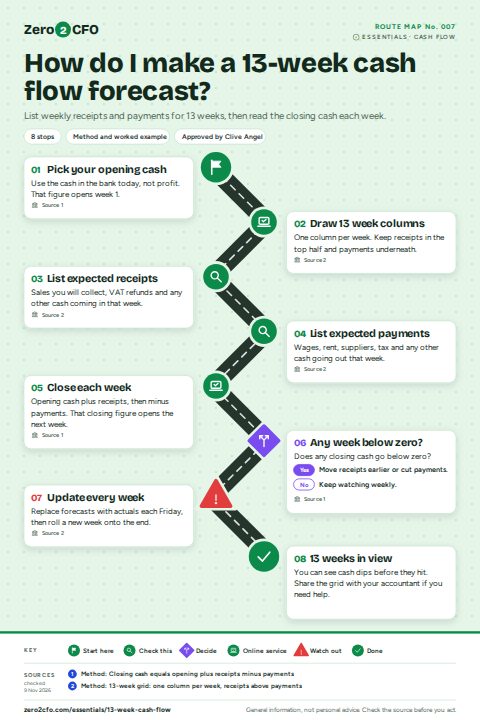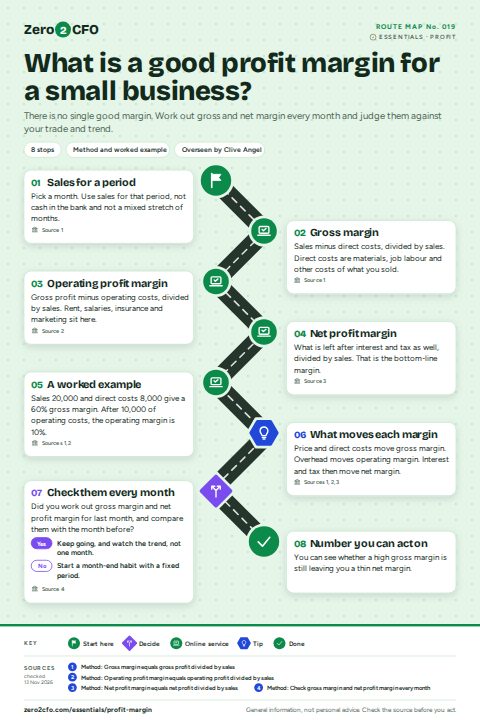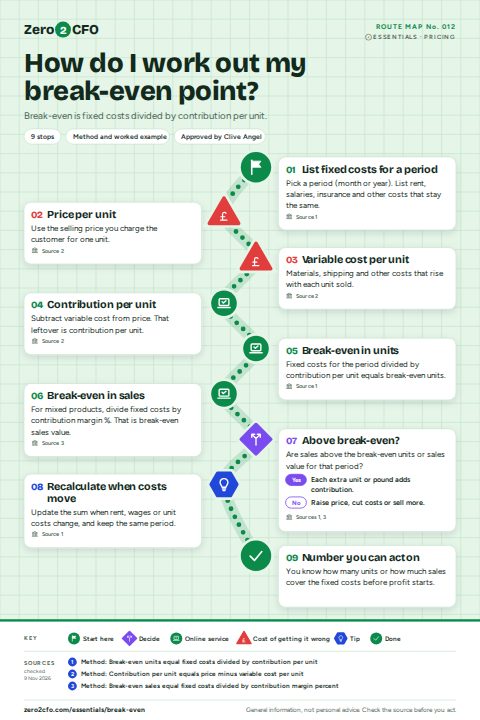
Cash runway is how many months your cash would last at your current monthly net cash burn. Net cash burn is cash out minus cash in. Use the average of the last three months, not one unusual month. There is no fixed number of months that is right for every business: judge the result against your trade and the months ahead. If the result is short, or a large payment such as a tax bill is coming, make a 13-week cash flow forecast. This page is general information, not personal advice.
The route, stop by stop
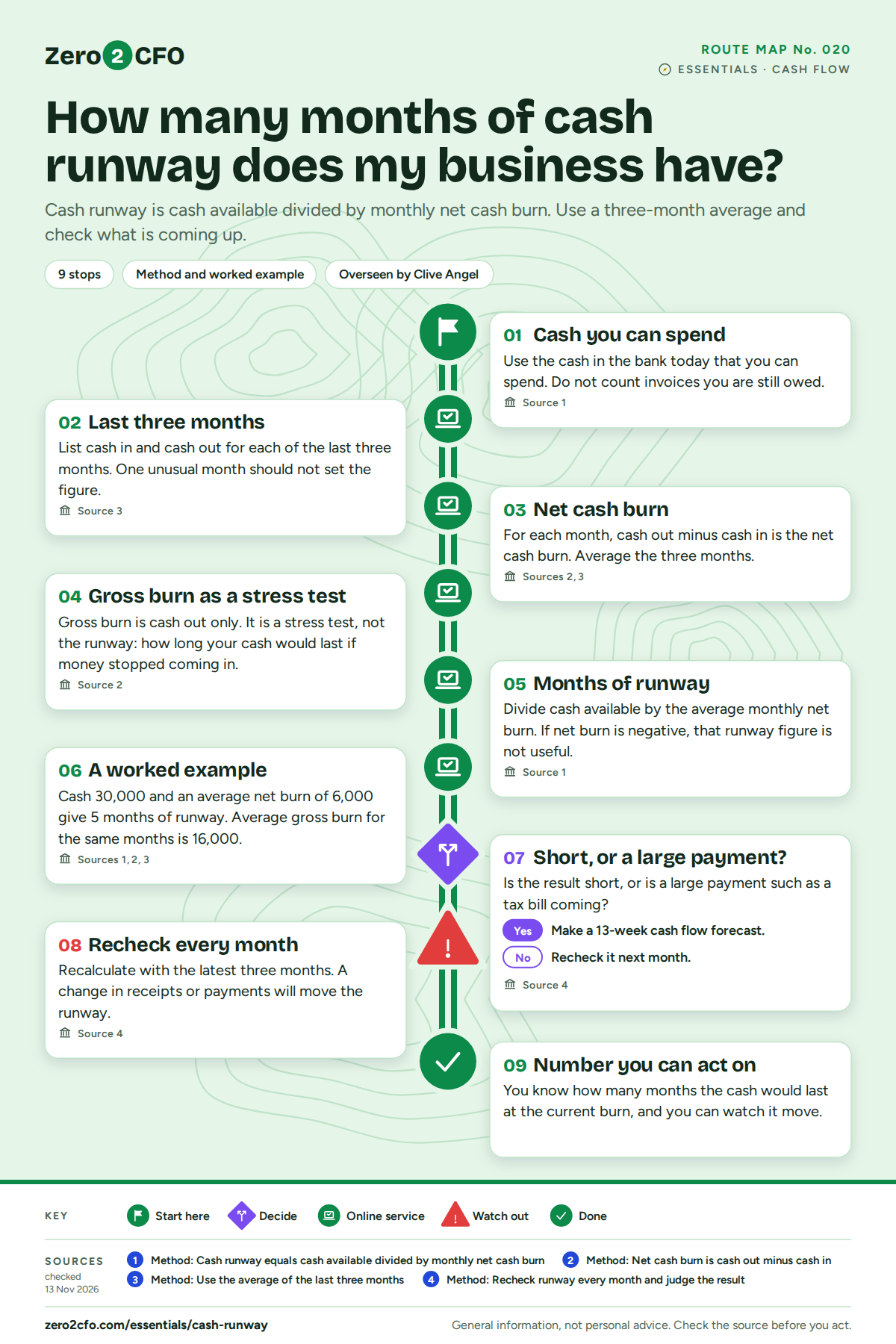
01Cash you can spend
Use the cash in the bank today that you can spend. Do not count invoices you are still owed.
Source 1
02Last three months
List cash in and cash out for each of the last three months. One unusual month should not set the figure.
Source 3
04Gross burn as a stress test
Gross burn is cash out only. It is a stress test, not the runway: how long your cash would last if money stopped coming in.
Source 2
05Months of runway
Divide cash available by the average monthly net burn. If net burn is negative, that runway figure is not useful.
Source 1
07Short, or a large payment?
Is the result short, or is a large payment such as a tax bill coming?
YesMake a 13-week cash flow forecast.NoRecheck it next month.Source 4
08Recheck every month
Recalculate with the latest three months. A change in receipts or payments will move the runway.
Source 4
09Number you can act on
You know how many months the cash would last at the current burn, and you can watch it move.
The formula
Cash runway is cash available divided by monthly net cash burn. Cash available is the cash in the bank that you can spend today. Do not count invoices you are still owed, and do not count money you have already set aside and cannot spend.
Net cash burn is cash out minus cash in for a month. Gross burn is cash out only. Runway uses net burn. Dividing cash by gross burn is not the runway. It is a stress test: it shows how long your cash would last if money stopped coming in.
Use the average net burn of the last three months, so one unusual month does not set the figure.
Worked example
In pounds: cash available is £30,000. In the last three months, cash in and cash out were £10,000 and £14,000, then £8,000 and £14,000, then £12,000 and £20,000. Net burn was £4,000, £6,000 and £8,000. The average net burn is £6,000. Runway is £30,000 ÷ £6,000 = 5 months.
Average gross burn for the same months is £16,000. £30,000 ÷ £16,000 = 1.875 months, just under two months. That shorter figure is not the runway. It is a stress test: it shows how long your cash would last if money stopped coming in.
In dollars: cash available is $30,000, and the same monthly figures give an average net burn of $6,000, a runway of 5 months, and an average gross burn of $16,000. These are the same figures, not a conversion from one currency to the other.
If cash in exceeds cash out
If the average net burn is negative, because cash in is higher than cash out, dividing cash by that figure does not give a useful number of months. You are not burning cash on average. Keep watching the next months, because that can change.
What a short runway means
There is no single number of months that is right for every small business. It depends on your trade and on what is coming up: a quiet season, a tax bill, a large supplier payment or a late customer. Check what is coming up. If the result is short, or a large payment such as a tax bill is coming, make a 13-week cash flow forecast so you can see the weeks that dip and move receipts or payments in time.
Recalculate every month with the latest three months, using the same method each time, and watch whether the figure is rising or falling.
Common questions
Is cash runway the same as profit?
No. It is a cash measure. A profitable month can still burn cash if customers have not yet paid, and a loss-making month can still add cash if you collect old invoices.
Should I use gross burn or net burn?
Use net burn, cash out minus cash in, for the runway. Gross burn is cash out only. Dividing cash by gross burn is a stress test: it shows how long your cash would last if money stopped coming in. It is not the runway.
What if cash in is higher than cash out?
The average net burn is then negative, and the runway figure is not useful. Keep watching the next months.
How many months of runway should I have?
There is no single good figure. Compare your own months, and judge the result against your trade and against what is coming up.
Is this the same as a 13-week cash flow forecast?
No. Runway is one number from recent months. A 13-week cash flow forecast shows the weeks ahead, week by week.
Is this personal advice?
No. It is general information, a worked method checked on 13 November 2026. Use your own figures.
Where this map sits
EssentialsKnow your numbers
The handful of figures that tell you how the business is really doing.
Where the rules and methods come from
- How it's worked out: Cash runway equals cash available divided by monthly net cash burn
Worked example: Cash 30,000, average monthly net burn 6,000, in pounds or dollars. Runway is 30,000 ÷ 6,000 = 5 months. - How it's worked out: Net cash burn is cash out minus cash in
Worked example: Cash in 10,000 and cash out 14,000. Net burn is 4,000. Gross burn is the 14,000 out. - How it's worked out: Use the average of the last three months
Worked example: Net burn of 4,000, 6,000 and 8,000. The average is 6,000. One unusual month should not set the figure. - How it's worked out: Recheck runway every month and judge the result
Worked example: Use the same method each time. Compare this month with last month. If the result is short, or a large payment such as a tax bill is coming, make a 13-week cash flow forecast.
This map is general information, not personal advice. Rules and rates change, so check the sources before you act. If your situation is tricky, talk to your accountant.