Break-even is the sales volume that covers fixed costs for a stated period. Contribution per unit is price minus variable cost. This page is general information, not personal advice.
The route, stop by stop
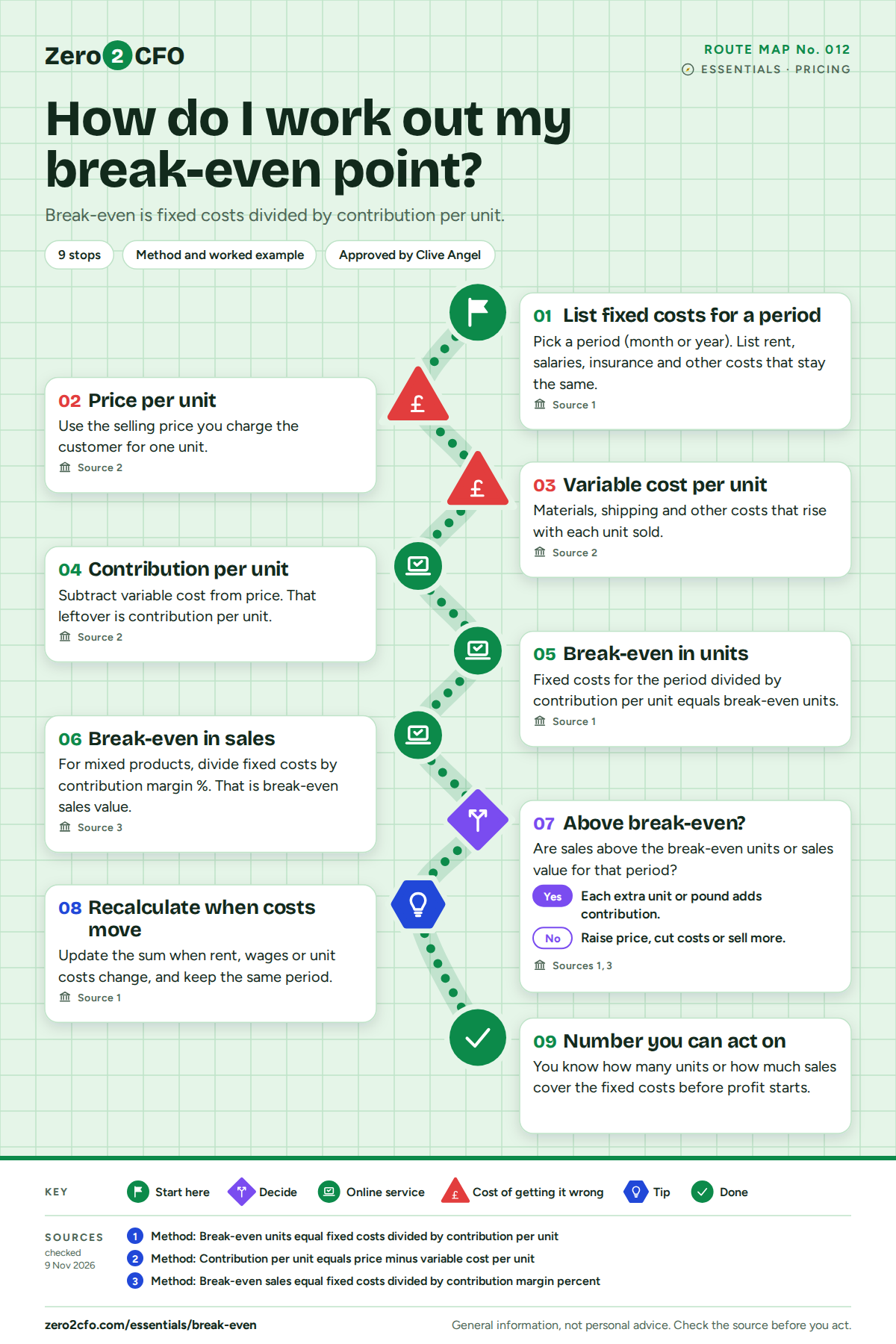
01List fixed costs for a period
Pick a period (month or year). List rent, salaries, insurance and other costs that stay the same.
Source 1
04Contribution per unit
Subtract variable cost from price. That leftover is contribution per unit.
Source 2
05Break-even in units
Fixed costs for the period divided by contribution per unit equals break-even units.
Source 1
06Break-even in sales
For mixed products, divide fixed costs by contribution margin %. That is break-even sales value.
Source 3
08Recalculate when costs move
Update the sum when rent, wages or unit costs change, and keep the same period.
Source 1
09Number you can act on
You know how many units or how much sales cover the fixed costs before profit starts.
The unit formula
Break-even units equal fixed costs for the period divided by contribution per unit. Contribution per unit equals price minus variable cost per unit.
Worked example (units)
Fixed costs £24,000 a year. Price £40. Variable cost £16. Contribution is £24. Break-even is 1,000 units a year, about 84 a month.
Break-even in sales value
Most owners sell more than one product. Contribution margin % is contribution per unit divided by price. Break-even sales equal fixed costs divided by that percentage. Example: £24 contribution on a £40 price is 60%. £24,000 ÷ 60% = £40,000 of sales a year.
How to use it
If sales sit below break-even for the period, raise price, cut variable cost, cut fixed cost or sell more. For a real break-even, include what you need to pay yourself in fixed costs. Recalculate when any input changes.
Common questions
Is break-even the same as cash flow?
No. It is a volume or sales target for a period. Cash timing still needs a cash forecast.
What counts as a fixed cost?
Costs that stay the same as volume changes in the period you are looking at, such as rent or base salaries.
Is this personal advice?
No. It is general information, a worked method checked on 9 November 2026. Use your own figures.
Where the rules and methods come from
- How it's worked out: Break-even units equal fixed costs divided by contribution per unit
Worked example: Fixed costs £24,000 a year. Price £40. Variable cost £16. Contribution £24. Break-even is 1,000 units a year, about 84 a month. - How it's worked out: Contribution per unit equals price minus variable cost per unit
Worked example: Sell at £40. Materials and shipping cost £16 each. Contribution per unit is £24. - How it's worked out: Break-even sales equal fixed costs divided by contribution margin percent
Worked example: Contribution £24 on a £40 price is a 60% margin. Fixed costs £24,000 a year ÷ 60% = £40,000 of sales a year.
This map is general information, not personal advice. Rules and rates change, so check the sources before you act. If your situation is tricky, talk to your accountant.