Markup is profit divided by cost. Margin is profit divided by price. Adding 40% to your cost is not a 40% margin. This page is general information, not personal advice.
The route, stop by stop
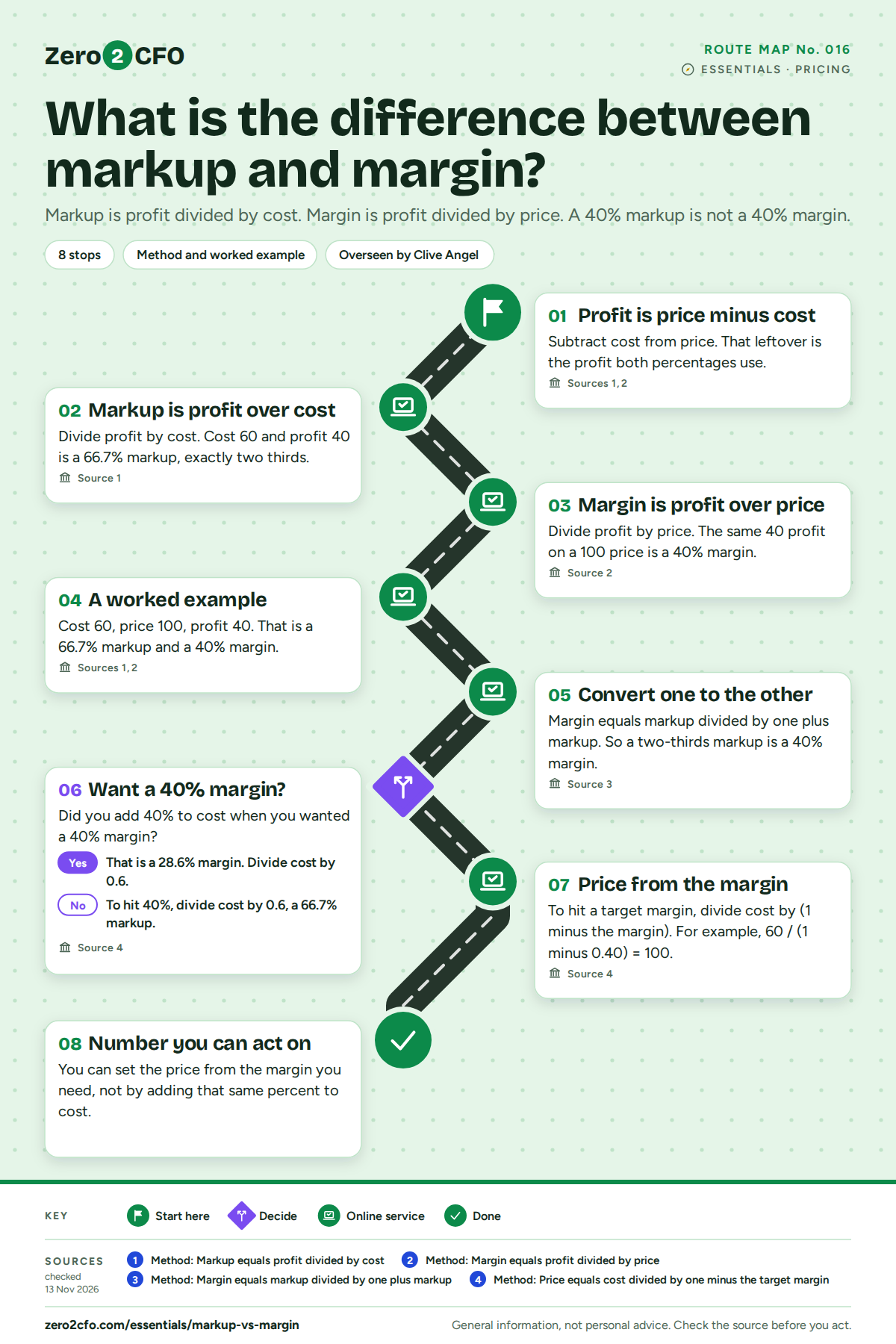
02Markup is profit over cost
Divide profit by cost. Cost 60 and profit 40 is a 66.7% markup, exactly two thirds.
Source 1
03Margin is profit over price
Divide profit by price. The same 40 profit on a 100 price is a 40% margin.
Source 2
05Convert one to the other
Margin equals markup divided by one plus markup. So a two-thirds markup is a 40% margin.
Source 3
06Want a 40% margin?
Did you add 40% to cost when you wanted a 40% margin?
YesThat is a 28.6% margin. Divide cost by 0.6.NoTo hit 40%, divide cost by 0.6, a 66.7% markup.Source 4
07Price from the margin
To hit a target margin, divide cost by (1 minus the margin). For example, 60 / (1 minus 0.40) = 100.
Source 4
08Number you can act on
You can set the price from the margin you need, not by adding that same percent to cost.
The two formulae
Profit is price minus cost. Markup equals profit divided by cost. Margin equals profit divided by price. They use the same profit, but they divide by different numbers, so they are not the same percentage. On a profitable sale, markup is always the higher of the two.
Worked example
In pounds: cost £60, price £100, profit £40. In dollars: cost $60, price $100, profit $40. These are the same figures, not a conversion from one currency to the other.
- Markup is 40 ÷ 60 = 66.7%, exactly two thirds.
- Margin is 40 ÷ 100 = 40%.
How to convert
Margin equals markup divided by one plus markup. Markup equals margin divided by one minus margin. Check: a two-thirds markup converts as (2/3) ÷ (1 + 2/3) = 40% margin. A 40% margin converts as 0.4 ÷ 0.6 = two thirds, a 66.7% markup.
The common pricing mistake
If you want a 40% margin and you add 40% to a £60 or $60 cost, the price is £84 or $84. Profit is £24 or $24. 24 ÷ 84 is about 28.6%, not 40%. To hit a 40% margin, divide cost by (1 minus the margin). 60 / (1 minus 0.40) = 100, which is a 66.7% markup.
Common questions
Are markup and margin the same?
No. Markup divides profit by cost. Margin divides profit by price. A 40% markup is not a 40% margin.
I added 40% to my cost. Is that a 40% margin?
No. That is a 40% markup. On a cost of £60 or $60 the price is £84 or $84 and the margin is about 28.6%.
How do I get the price for a margin I want?
Divide cost by (1 minus the margin). For a 40% margin, 60 / (1 minus 0.40) = 100.
Is this personal advice?
No. It is general information, a worked method checked on 13 November 2026. Use your own figures.
Where this map sits
EssentialsKnow your numbers
The handful of figures that tell you how the business is really doing.
Where the rules and methods come from
- How it's worked out: Markup equals profit divided by cost
Worked example: Cost 60, price 100, in pounds or dollars. Profit is 40. Markup is 40 ÷ 60 = 66.7%, exactly two thirds. - How it's worked out: Margin equals profit divided by price
Worked example: Cost 60, price 100, in pounds or dollars. Profit is 40. Margin is 40 ÷ 100 = 40%. - How it's worked out: Margin equals markup divided by one plus markup
Worked example: A two-thirds markup (66.7%) converts as (2/3) ÷ (1 + 2/3) = 40% margin. - How it's worked out: Price equals cost divided by one minus the target margin
Worked example: A 40% markup on cost 60 gives a price of 84 and about a 28.6% margin, not 40%. A 40% margin is 60 / (1 minus 0.40) = 100.
This map is general information, not personal advice. Rules and rates change, so check the sources before you act. If your situation is tricky, talk to your accountant.