File a Union or non-Union OSS VAT return for each calendar quarter, and an IOSS return for each calendar month, by the end of the following month, together with any VAT due. If you made no supplies under the scheme in that period, you must still send a nil return. This page is general information, not tax advice.
The route, stop by stop
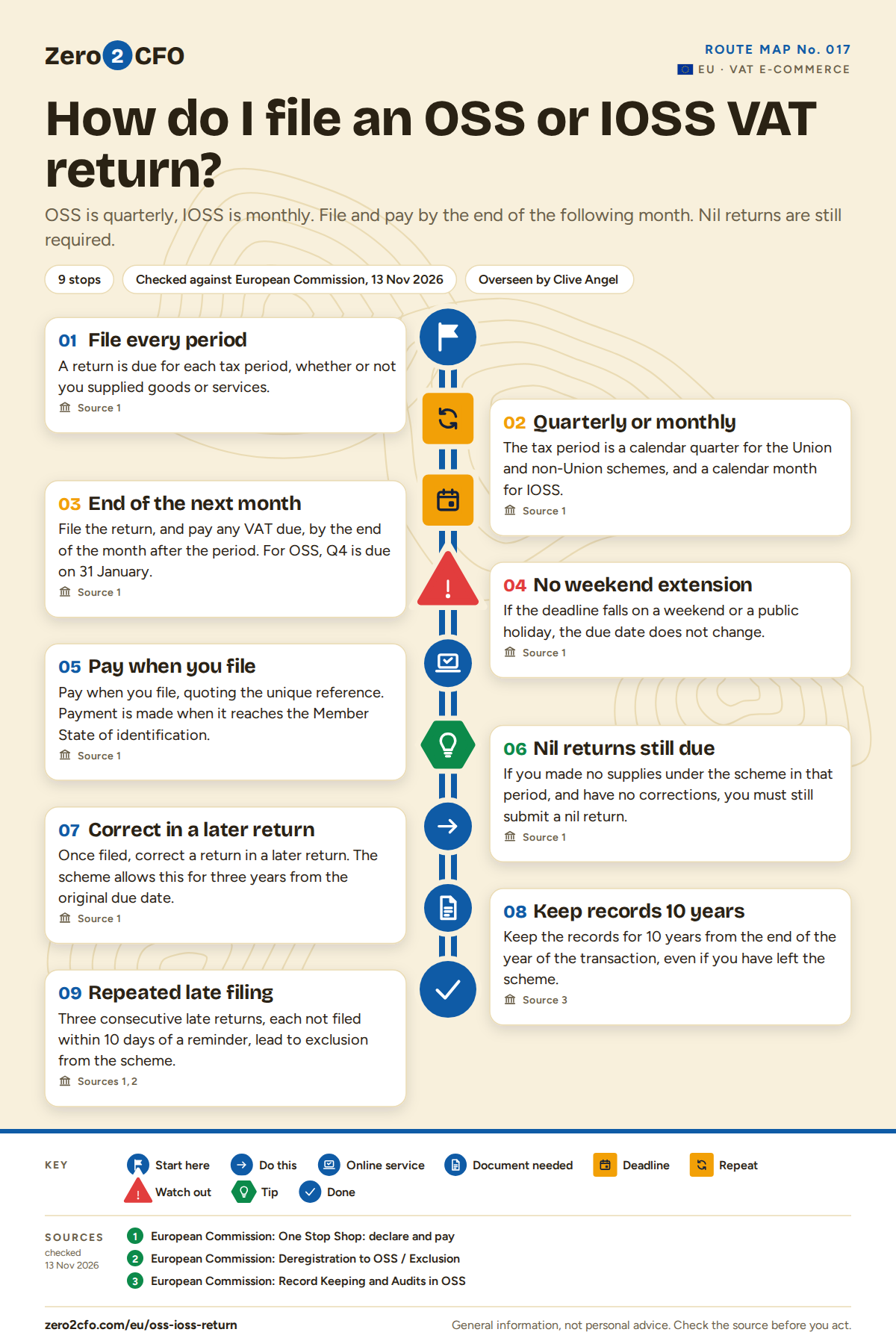
01File every period
A return is due for each tax period, whether or not you supplied goods or services.
Source 1
02Quarterly or monthly
The tax period is a calendar quarter for the Union and non-Union schemes, and a calendar month for IOSS.
Source 1
03End of the next month
File the return, and pay any VAT due, by the end of the month after the period. For OSS, Q4 is due on 31 January.
Source 1
04No weekend extension
If the deadline falls on a weekend or a public holiday, the due date does not change.
Source 1
05Pay when you file
Pay when you file, quoting the unique reference. Payment is made when it reaches the Member State of identification.
Source 1
06Nil returns still due
If you made no supplies under the scheme in that period, and have no corrections, you must still submit a nil return.
Source 1
07Correct in a later return
Once filed, correct a return in a later return. The scheme allows this for three years from the original due date.
Source 1
08Keep records 10 years
Keep the records for 10 years from the end of the year of the transaction, even if you have left the scheme.
Source 3
The tax period
The tax period is the calendar quarter for the Union and non-Union schemes, and the calendar month for the import scheme (IOSS). You must submit the return electronically to your Member State of identification. You may not submit it before the end of the return period.
When to file and pay
The return, and the accompanying payment, are due by the end of the month following the tax period. For Union and non-Union OSS, that is:
- Q1, 1 January to 31 March: 30 April
- Q2, 1 April to 30 June: 31 July
- Q3, 1 July to 30 September: 31 October
- Q4, 1 October to 31 December: 31 January of the following year
For IOSS, each calendar month is a tax period, so the December return is also due on 31 January. There is no change to the deadline if that date falls on a weekend or a public holiday. 31 January 2027 is a Sunday; the due date stays 31 January 2027. 31 July 2027 is a Saturday and 31 October 2027 is a Sunday; those dates do not move either.
Pay when you file, and quote the unique reference number that the Member State of identification gives you for that return. If you do not pay at the same time, pay by the same deadline. Payment is made when it reaches the bank account of the Member State of identification. That state sets out how to pay. It cannot offer a payment plan for One Stop Shop VAT; any delayed payment arrangement is a matter for the Member State of consumption.
Nil returns
If you made no supplies under the scheme in that period, and you have no corrections to earlier returns, you must still submit a nil return.
Corrections
You can change a return at any time before you submit it. Once it has been submitted, corrections for tax periods starting on 1 July 2021 must be made in a later return. The Member State of identification lets you do this electronically for three years from the date the original return had to be submitted. After that, the Member State of consumption may still accept a correction under its own national rules, in which case you contact that state directly. Those later corrections are not part of the One Stop Shop scheme.
Records
Keep the records for 10 years from the end of the year in which the transaction was made, even if you have stopped using the scheme. They must be made available electronically, on request, without delay. A failure to provide them within a month of a reminder from the Member State of identification is treated as a persistent failure to comply, and leads to exclusion.
If you file or pay late
If a return is late, the Member State of identification sends an electronic reminder on the tenth day after the due date. Further reminders, and any penalties or charges for late filing or late payment, are a matter for the Member State of consumption, under its own rules.
If you receive a reminder for three consecutive return periods, and you do not submit each of those returns within 10 days of the reminder, you will be excluded from the scheme. The same pattern applies to unpaid VAT, unless the amount outstanding for each return is less than EUR 100. Exclusion for persistent failure is followed by a quarantine period of 2 years, during which you cannot use any of the three schemes.
Common questions
Does the deadline move if it falls on a Sunday?
No. The Commission page says there is no change to the deadline if the date falls on the weekend or on a public holiday. 31 January 2027, the due date for the OSS Q4 return and the December IOSS return, is a Sunday and stays 31 January 2027.
Can I file before the period has ended?
No. You may not submit the return before the end of the return period.
How do I pay?
The Member State of identification sets out how to pay. Quote the unique reference number for that return. Payment is made when it reaches that state's bank account.
What if I have already filed, and I need to correct a figure?
Make the correction in a later return, within three years of the original due date. After that, contact the Member State of consumption directly.
Is this tax advice?
No. It is general information from Commission pages checked on 13 November 2026. Rules change, so check the sources before you act. Where payment methods, penalties or late corrections differ, ask the tax authority in the Member State of identification or the Member State of consumption.
Where this map sits
EUSelling goods to EU customers
How VAT works when your parcels cross the border.
Where the rules come from
- European Commission: One Stop Shop: declare and pay checked 13 November 2026
- European Commission: Deregistration to OSS / Exclusion checked 13 November 2026
- European Commission: Record Keeping and Audits in OSS checked 13 November 2026
This map is general information, not personal advice. Rules and rates change, so check the sources before you act. If your situation is tricky, talk to your accountant or tax adviser.