For most services supplied to a business customer, the place of taxation is where that customer is established. If you are not established in the customer's EU country, the customer accounts for the VAT, and your invoice must include the words 'reverse charge'. This page is general information, not tax advice.
The route, stop by stop
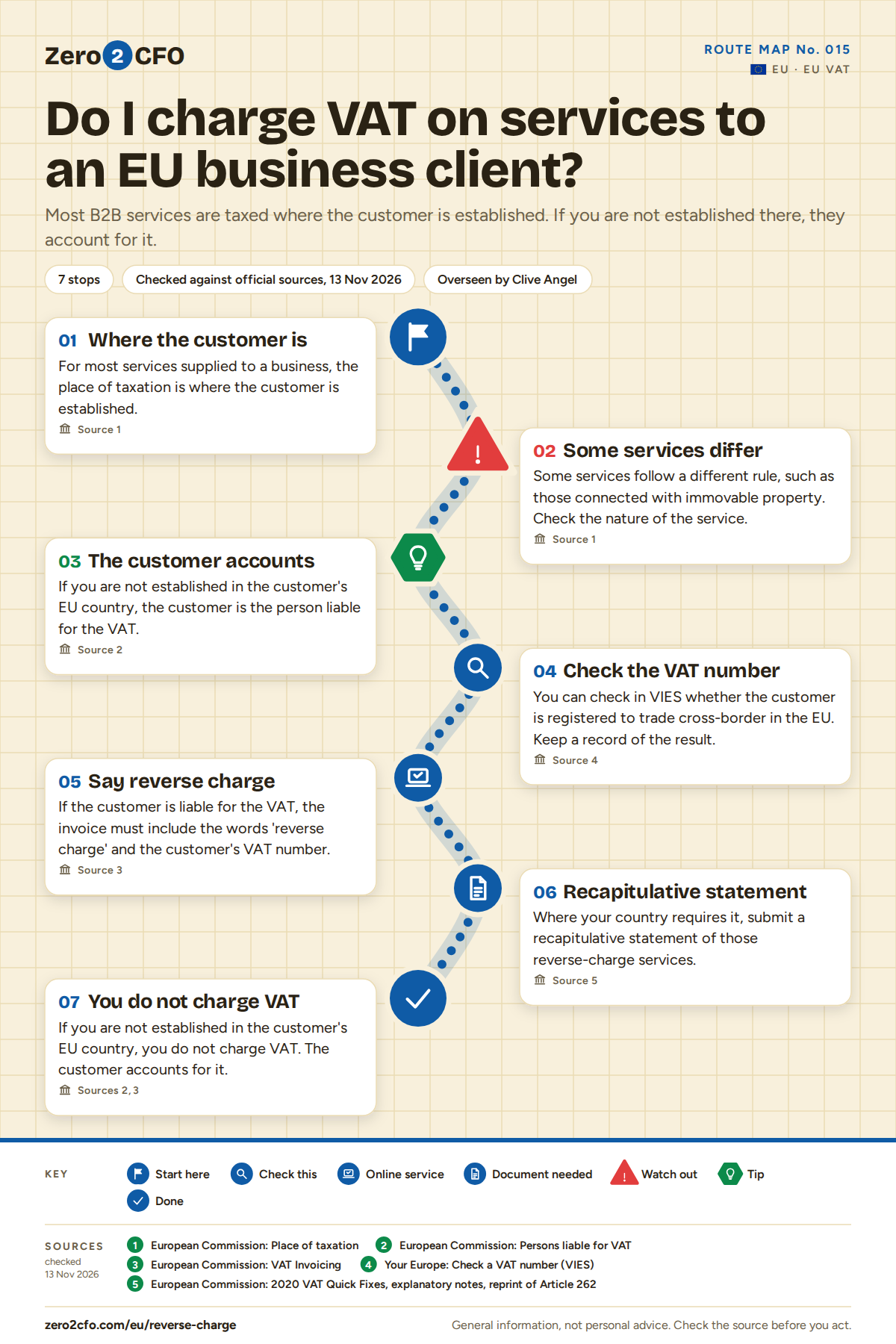
01Where the customer is
For most services supplied to a business, the place of taxation is where the customer is established.
Source 1
02Some services differ
Some services follow a different rule, such as those connected with immovable property. Check the nature of the service.
Source 1
03The customer accounts
If you are not established in the customer's EU country, the customer is the person liable for the VAT.
Source 2
04Check the VAT number
You can check in VIES whether the customer is registered to trade cross-border in the EU. Keep a record of the result.
Source 4
05Say reverse charge
If the customer is liable for the VAT, the invoice must include the words 'reverse charge' and the customer's VAT number.
Source 3
06Recapitulative statement
Where your country requires it, submit a recapitulative statement of those reverse-charge services.
Source 5
Where the VAT is due
For services between businesses, the place of taxation is usually where the customer is established. That is the default rule in Article 44 of the VAT Directive. There are exceptions. Services connected with immovable property, for example, are taxed where the property is located. The Commission page on the place of taxation lists the other exceptions, including certain transport, admission to events, and restaurant and catering services.
When the customer accounts for the VAT
Under Article 196, the customer is liable for the VAT when all of these apply:
- the customer is a business acting as such, or a non-taxable legal person registered for VAT
- the place of supply is where the customer is established (the default rule for services to taxable persons)
- you are not established in the customer's EU country
The customer then accounts for the VAT in that country. You do not charge VAT on the invoice.
Checking the customer's VAT number
You can check whether a business is registered to trade cross-border in the EU with the Commission's VIES tool. Your Europe recommends that you keep a record of the check, in case of a tax control. If VIES does not confirm a number the customer says is valid, they can ask their own tax office to verify it. That procedure varies between EU countries.
The invoice
If the customer is liable for the tax under the reverse-charge procedure, the invoice must include the words 'reverse charge' and the customer's VAT identification number.
Recapitulative statements
Where your country requires it, you submit a recapitulative statement of the taxable persons, and the non-taxable legal persons identified for VAT purposes, to whom you have supplied services for which the recipient is liable under Article 196, other than services that are exempt in the Member State where the transaction is taxable. How and when you file is set by the Member State in which you are identified for VAT. Ask that tax authority. There is no single EU-wide filing date.
Common questions
Does this apply to every service I sell to an EU business?
No. The default rule is that the place of taxation is where the customer is established, but some services follow a different rule. Check the nature of the service on the Commission's place of taxation page.
What if I am established in the same EU country as the customer?
The Article 196 reverse charge described here applies when you are not established in the customer's EU country. Domestic VAT in that country is a matter for that tax authority.
What if VIES does not confirm the number?
The customer can ask their tax office to verify it. The procedure varies between EU countries. You can also ask your own national tax authority for more information.
Is this tax advice?
No. It is general information from Commission and Your Europe pages checked on 13 November 2026. Rules change, so check the sources before you act. Where filing dates, registration or a VIES result need a national answer, ask the tax authority in the relevant Member State.
Where the rules come from
- European Commission: Place of taxation checked 13 November 2026
- European Commission: Persons liable for VAT checked 13 November 2026
- European Commission: VAT Invoicing checked 13 November 2026
- Your Europe: Check a VAT number (VIES) checked 13 November 2026
- European Commission: 2020 VAT Quick Fixes, explanatory notes, reprint of Article 262 checked 13 November 2026
This map is general information, not personal advice. Rules and rates change, so check the sources before you act. If your situation is tricky, talk to your accountant or tax adviser.