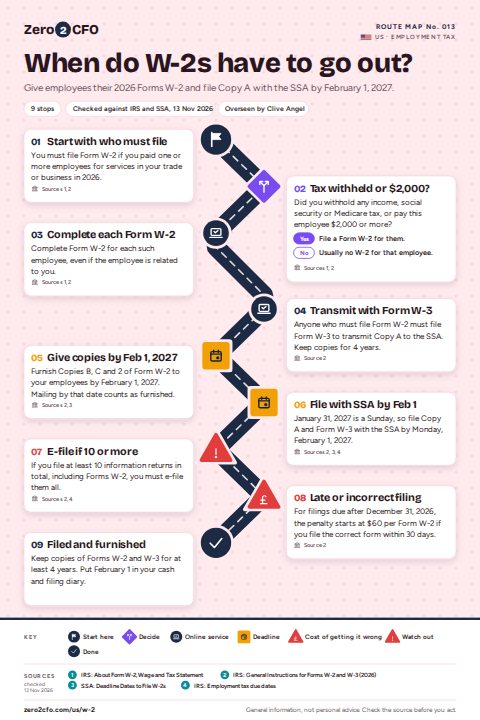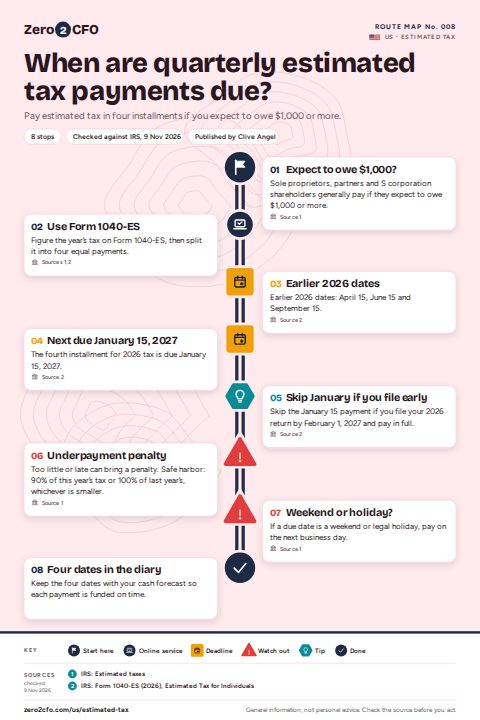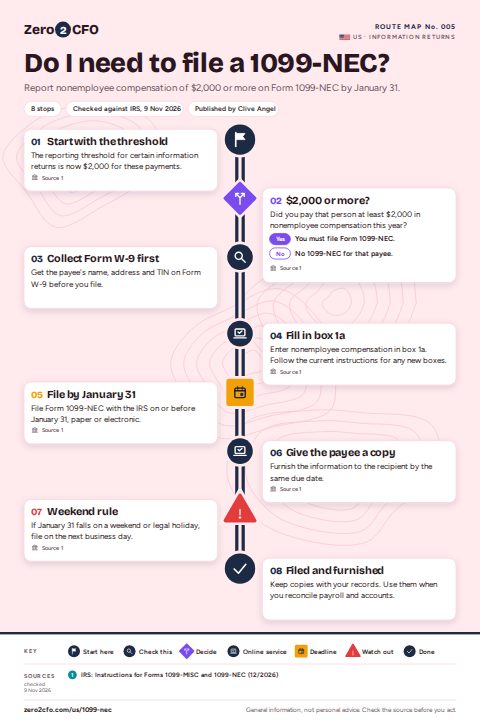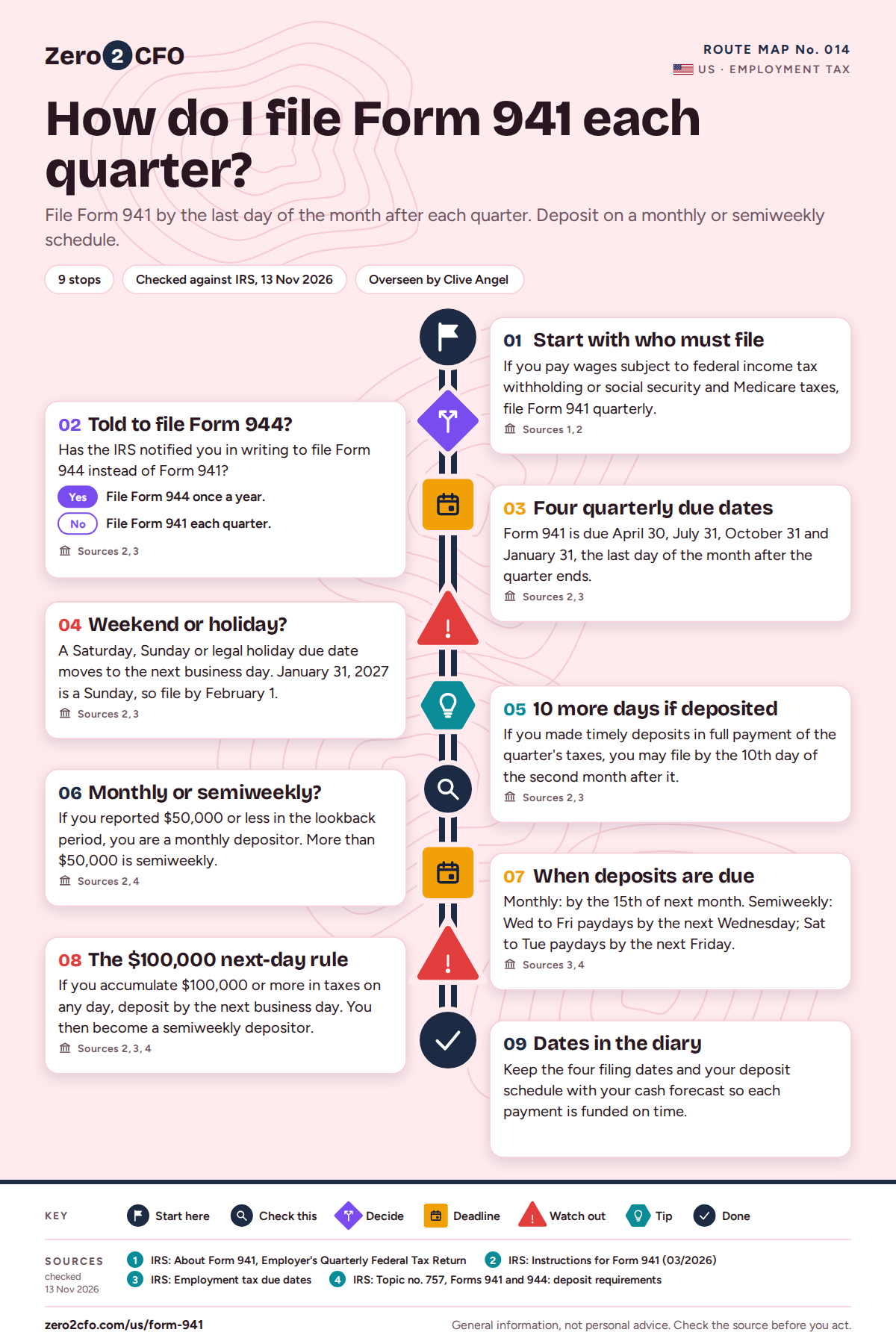
If you pay wages subject to federal income tax withholding or social security and Medicare taxes, file Form 941 each quarter, unless the IRS has told you in writing to file Form 944. This page is general information, not tax advice.
The route, stop by stop
09Dates in the diary
Keep the four filing dates and your deposit schedule with your cash forecast so each payment is funded on time.
Form 944
File Form 944 annually only if the IRS has notified you in writing to do so. Until you receive written confirmation that your filing requirement has changed, keep filing the form the IRS previously told you to file. If you believe your employment taxes for 2026 will be $1,000 or less, you may request to file Form 944, but you must wait for written notice before you switch.
When Form 941 is due
Form 941 is due by the last day of the month that follows the end of the quarter: April 30, July 31, October 31 and January 31. After you file your first Form 941, you must file a return for each quarter, even if you have no taxes to report, unless you filed a final return or you are a seasonal employer who paid no wages that quarter.
If a due date falls on a Saturday, Sunday or legal holiday, you may file on the next business day. January 31, 2027 is a Sunday, so the fourth-quarter 2026 return may be filed by Monday, February 1, 2027. July 31, 2027 is a Saturday, so that due date moves to Monday, August 2, 2027. October 31, 2027 is a Sunday, so that due date moves to Monday, November 1, 2027. April 30, 2027 is a Friday.
Extra time if you deposited on time
If you made timely deposits in full payment of your taxes for the quarter, you may file by the 10th day of the second month after the quarter ends. For the fourth quarter of 2026, that date is February 10, 2027. For the first quarter, it is May 10.
Monthly or semiweekly deposits
Your deposit schedule is not set by how often you pay your employees. It depends on the total tax liability you reported on Form 941 in the lookback period: July 1 of the second preceding calendar year through June 30 of the preceding calendar year. For 2026, that period is July 1, 2024 through June 30, 2025. If you filed Form 944 in 2024 or 2025, the lookback period is the 2024 calendar year. New employers are treated as having zero tax in any quarter before the business started, so they are monthly depositors in the first year unless the $100,000 next-day rule applies.
If you reported $50,000 or less in the lookback period, you are a monthly schedule depositor: deposit taxes on payments made during a month by the 15th day of the following month. If you reported more than $50,000, you are a semiweekly schedule depositor: deposit taxes for Wednesday to Friday paydays by the following Wednesday, and for Saturday to Tuesday paydays by the following Friday. If a deposit due date is not a business day, deposit by the close of the next business day. A business day is any day other than a Saturday, Sunday or legal holiday.
The $100,000 next-day rule
If you accumulate $100,000 or more in taxes on any day during a deposit period, deposit those taxes by the next business day. You then become a semiweekly schedule depositor for at least the rest of that calendar year and the following calendar year.
Paying with the return
If your employment tax liability for the current quarter or the prior quarter is less than $2,500, and you did not incur a $100,000 next-day deposit obligation during the current quarter, you may pay the current quarter's taxes with a timely filed return instead of making deposits.
Common questions
Do I still have to deposit if I get the extra 10 days to file?
Yes. The extra time is only for filing the return, and only if you already deposited all taxes for the quarter on time and in full. Deposit due dates do not move with that 10-day filing rule.
What if I sell the business or stop paying wages?
If you sell or transfer the business during the quarter, you and the new owner must each file Form 941 for that quarter, reporting only the wages you paid. If you permanently stop paying wages, file a final return and check the box on line 17.
Is this tax advice?
No. It is general information from IRS pages checked on November 13, 2026. Rules change, so check the sources before you act.
Where this map sits
USThe January filings
What a US owner has to pay and file as the year turns.
Where the rules come from
- IRS: About Form 941, Employer's Quarterly Federal Tax Return checked 13 November 2026
- IRS: Instructions for Form 941 (03/2026) checked 13 November 2026
- IRS: Employment tax due dates checked 13 November 2026
- IRS: Topic no. 757, Forms 941 and 944: deposit requirements checked 13 November 2026
This map is general information, not personal advice. Rules and rates change, so check the sources before you act. If your situation is tricky, talk to your CPA or tax adviser.