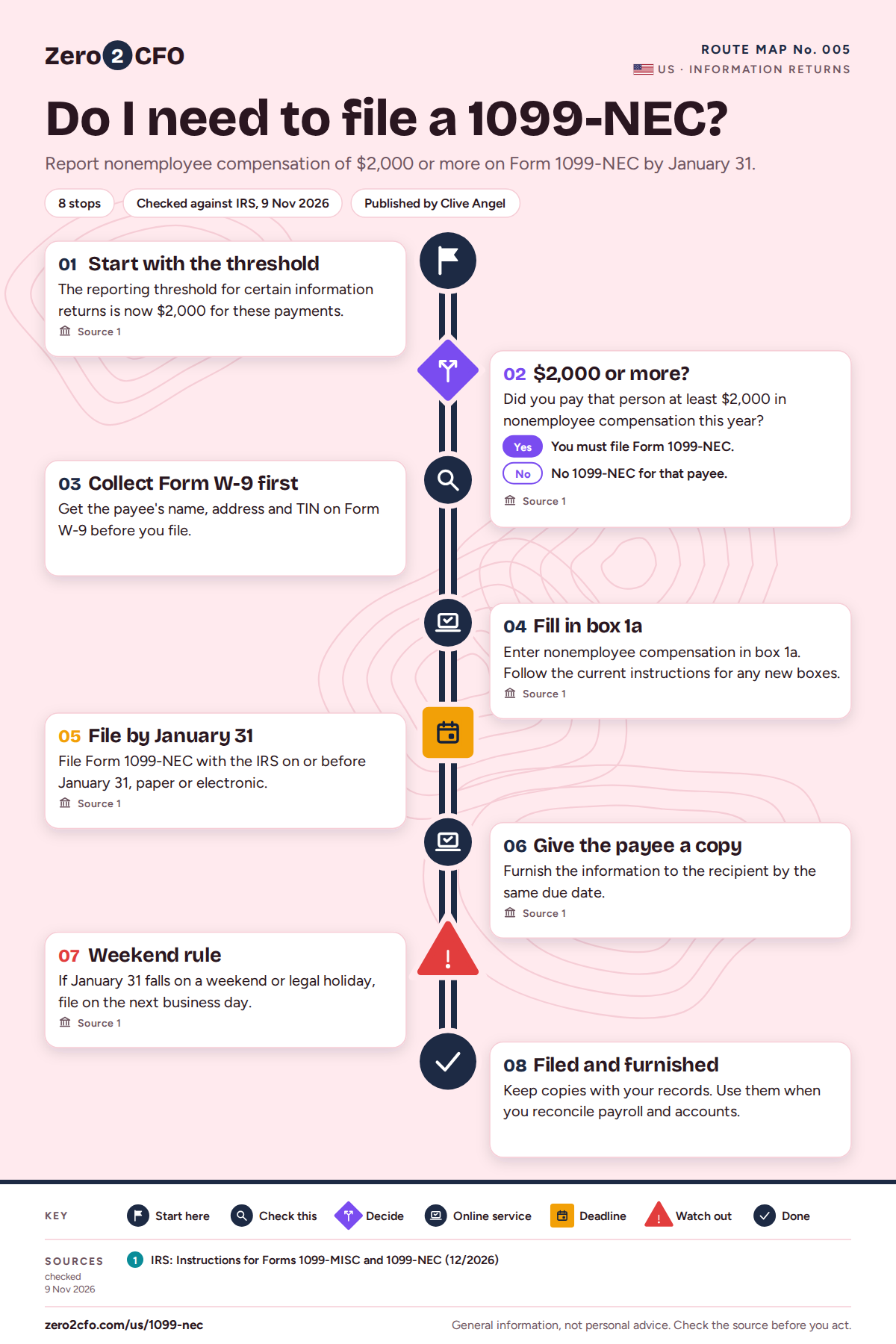
If you paid at least $2,000 in nonemployee compensation, file Form 1099-NEC on or before January 31. Furnish the information to the recipient too. This page is general information, not tax advice.
The route, stop by stop
01Start with the threshold
The reporting threshold for certain information returns is now $2,000 for these payments.
Source 1
02$2,000 or more?
Did you pay that person at least $2,000 in nonemployee compensation this year?
YesYou must file Form 1099-NEC.NoNo 1099-NEC for that payee.Source 1
03Collect Form W-9 first
Get the payee's name, address and TIN on Form W-9 before you file.
04Fill in box 1a
Enter nonemployee compensation in box 1a. Follow the current instructions for any new boxes.
Source 1
05File by January 31
File Form 1099-NEC with the IRS on or before January 31, paper or electronic.
Source 1
07Weekend rule
If January 31 falls on a weekend or legal holiday, file on the next business day.
Source 1
08Filed and furnished
Keep copies with your records. Use them when you reconcile payroll and accounts.
The $2,000 threshold
For payments in calendar year 2026, the reporting threshold on Form 1099-NEC is $2,000. The IRS may adjust that amount for inflation from 2027.
The January 31 deadline
Section 6071(c) requires you to file Form 1099-NEC on or before January 31, on paper or electronically. Furnish the information to the recipient by the same date. If January 31 is a weekend or legal holiday, use the next business day.
Common questions
When is the threshold $2,000?
For payments made in 2026, per the current Instructions for Forms 1099-MISC and 1099-NEC.
Do I need a W-9?
Yes. Collect the payee's TIN and details on Form W-9 before you file.
What if January 31 is a Saturday?
File on the next business day.
Is this tax advice?
No. It is general information from IRS pages checked on 9 November 2026. Rules change, so check the sources before you act.
Where the rules come from
- IRS: Instructions for Forms 1099-MISC and 1099-NEC (12/2026) checked 9 November 2026
This map is general information, not personal advice. Rules and rates change, so check the sources before you act. If your situation is tricky, talk to your CPA or tax adviser.