If a business or public authority pays you late, and the Late Payment Directive applies, you are automatically entitled to interest and to at least EUR 40 for recovery costs. Businesses must pay within 60 days, unless they expressly agree otherwise and that is not grossly unfair. Public authorities must pay within 30 days, or within 60 days in very exceptional circumstances. If your contract is governed by the laws of a non-EU country, these rules might not apply. This page is general information, not legal advice.
The route, stop by stop
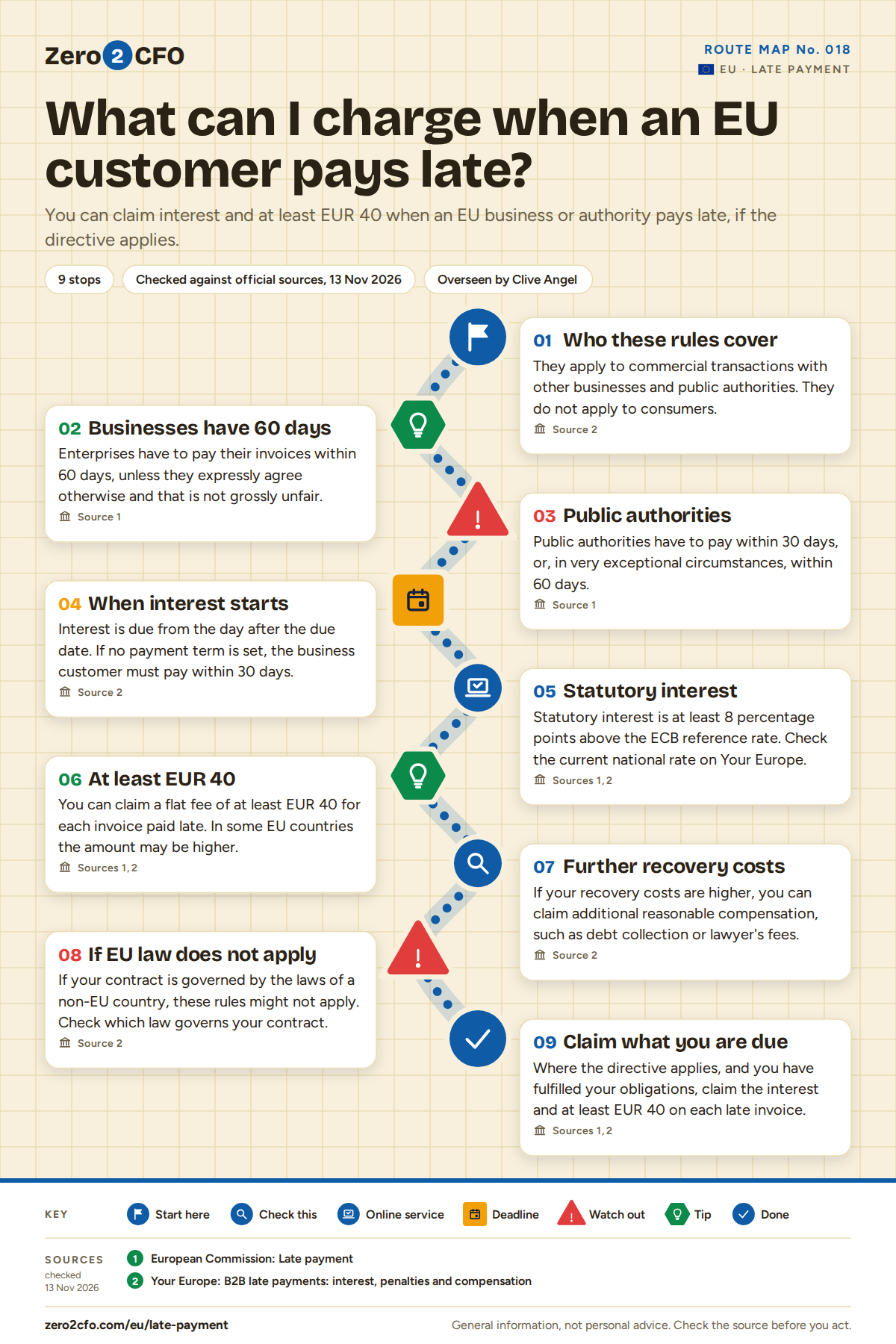
01Who these rules cover
They apply to commercial transactions with other businesses and public authorities. They do not apply to consumers.
Source 2
02Businesses have 60 days
Enterprises have to pay their invoices within 60 days, unless they expressly agree otherwise and that is not grossly unfair.
Source 1
03Public authorities
Public authorities have to pay within 30 days, or, in very exceptional circumstances, within 60 days.
Source 1
04When interest starts
Interest is due from the day after the due date. If no payment term is set, the business customer must pay within 30 days.
Source 2
07Further recovery costs
If your recovery costs are higher, you can claim additional reasonable compensation, such as debt collection or lawyer's fees.
Source 2
08If EU law does not apply
If your contract is governed by the laws of a non-EU country, these rules might not apply. Check which law governs your contract.
Source 2
Who the rules cover
The rules apply to commercial transactions with other businesses, including sole traders acting in the course of their independent economic or professional activity, and with public authorities. You cannot claim late payment interest in transactions with consumers. They also do not apply in insolvency proceedings, including proceedings aimed at debt restructuring, or to compensation payments for damages, for example by insurance companies.
You are entitled to interest and compensation when you have fulfilled your contractual and legal obligations and the client is responsible for the delay, that is, it is not due to circumstances beyond their control.
How long the customer has to pay
Enterprises have to pay their invoices within 60 days, unless they expressly agree otherwise and provided it is not grossly unfair. Public authorities have to pay for the goods and services that they procure within 30 days or, in very exceptional circumstances, within 60 days. EU countries may set rules that are more favourable to the creditor than these limits.
When interest starts
The interest is due from the day following the due date fixed in the contract. If you have not fixed a payment period in the contract, the business customer must pay within 30 days, and interest becomes automatically payable 30 calendar days after the client receives your invoice or payment request. If you do not know when the invoice was received, you can claim interest 30 calendar days after you delivered your goods or services. If you send the invoice before you deliver, the countdown starts only after delivery.
How much interest
For a business customer, you can charge the interest rate agreed in the contract. If no rate was agreed, the statutory rate applies. For a public authority, you charge interest at the statutory rate. Statutory interest is at least 8 percentage points above the European Central Bank's reference rate. The current statutory rate for each EU country is published on Your Europe, together with an interest calculator. Do not rely on an old table. Check the rate for the period that applies to your invoice.
Recovery costs
In addition to the interest, you can claim a flat compensation fee of at least EUR 40, or the equivalent, for each invoice paid late. In certain EU countries the amount may be higher. If your recovery costs exceed that fee, you can claim additional reasonable compensation, such as administrative costs, debt collection fees or the cost of instructing a lawyer.
You charge interest on the gross amount of the debt, including VAT, but you do not pay VAT on the interest.
If you are not in the EU
Your Europe explains that if no law was chosen when you signed the contract, the late payment rules are governed by the law of the country where the creditor has his habitual residence. If your contract is governed by the laws of a non-EU country, these rules might not apply. Check which law governs your contract.
Common questions
Can I claim this from a consumer?
No. You cannot claim late payment interest in transactions with consumers.
Is the compensation always EUR 40?
It is at least EUR 40 for each invoice paid late. In certain EU countries the amount may be higher. You can also claim further reasonable recovery costs if they exceed that fee.
Does this apply if I am based outside the EU?
Only if the Late Payment Directive applies to the contract. If your contract is governed by the laws of a non-EU country, these rules might not apply. If no law was chosen, Your Europe says the late payment rules follow the law of the country where the creditor has his habitual residence.
Do I pay VAT on the interest?
You charge interest on the gross amount of the debt, including VAT, but you do not pay VAT on the interest.
Is this legal advice?
No. It is general information from Commission and Your Europe pages checked on 13 November 2026. Rules change, so check the sources before you act. Where the amount, the interest rate or the time limit depends on national law, check Your Europe and the authority in the relevant Member State.
Where the rules come from
- European Commission: Late payment checked 13 November 2026
- Your Europe: B2B late payments: interest, penalties and compensation checked 13 November 2026
This map is general information, not personal advice. Rules and rates change, so check the sources before you act. If your situation is tricky, talk to your accountant or tax adviser.