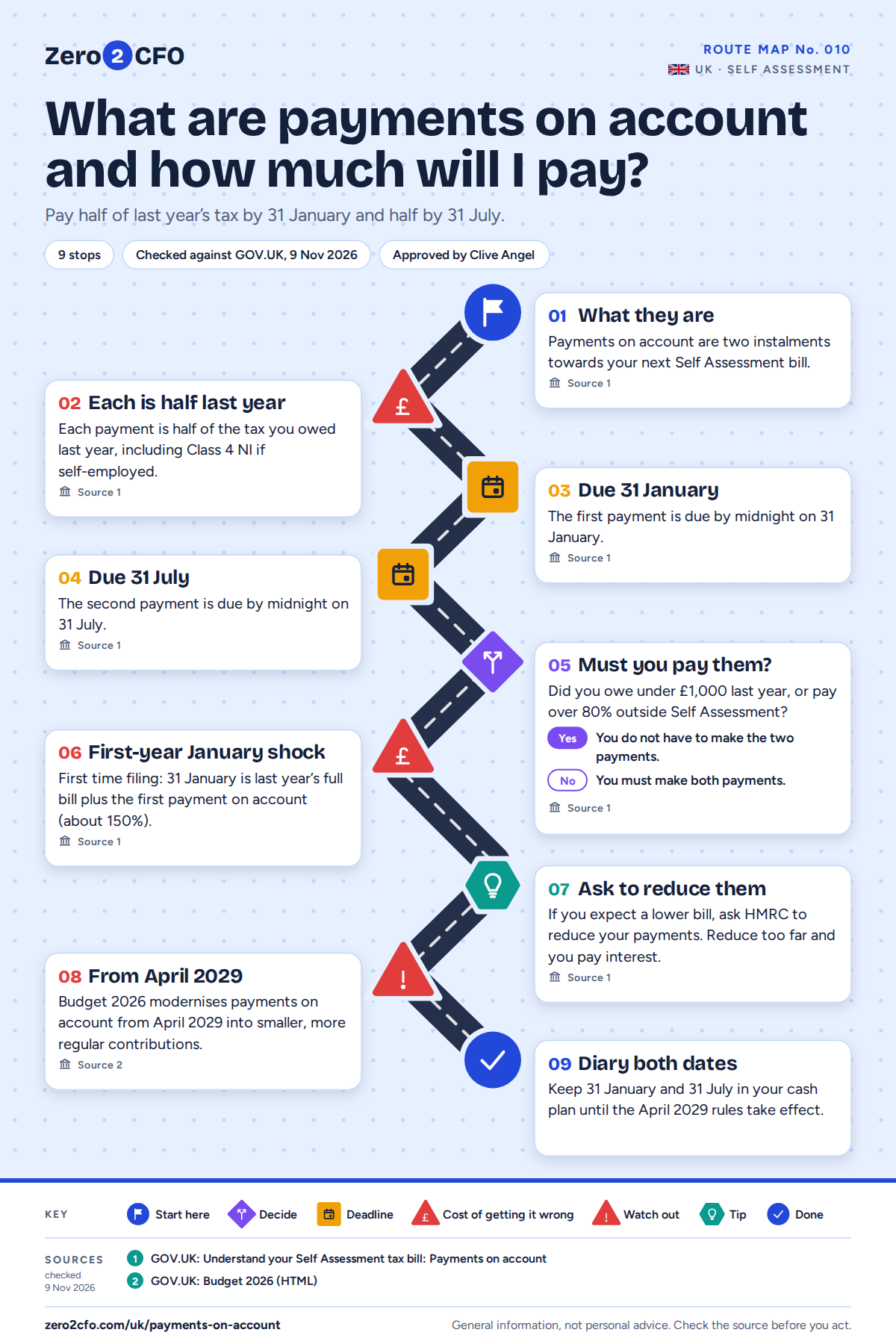
Payments on account spread your next Self Assessment bill into two equal instalments. This page is general information, not tax advice.
The route, stop by stop
01What they are
Payments on account are two instalments towards your next Self Assessment bill.
Source 1
02Each is half last year
Each payment is half of the tax you owed last year, including Class 4 NI if self-employed.
Source 1
05Must you pay them?
Did you owe under £1,000 last year, or pay over 80% outside Self Assessment?
YesYou do not have to make the two payments.NoYou must make both payments.Source 1
06First-year January shock
First time filing: 31 January is last year’s full bill plus the first payment on account (about 150%).
Source 1
07Ask to reduce them
If you expect a lower bill, ask HMRC to reduce your payments. Reduce too far and you pay interest.
Source 1
08From April 2029
Budget 2026 modernises payments on account from April 2029 into smaller, more regular contributions.
Source 2
09Diary both dates
Keep 31 January and 31 July in your cash plan until the April 2029 rules take effect.
How much and when
Each payment is half of the tax you owed last year. They are due by midnight on 31 January and 31 July.
Who can skip them
You must make the two payments unless last year’s tax was less than £1,000, or last year you paid more than 80% of the tax you owed outside Self Assessment.
How much on 31 January
If you did not make payments on account last year, 31 January is the full tax bill for last year plus the first payment on account towards this year. On GOV.UK’s example, a £3,000 bill means £4,500 due that day (£3,000 plus a £1,500 first payment on account).
If you already made payments on account last year, 31 January is any balancing payment plus the first payment on account for the next year.
Payments on account do not cover capital gains or student loan amounts. Those sit in the balancing payment if you owe them.
Ask to reduce them
If you expect this year’s bill to be lower, you can ask HMRC to reduce your payments on account online or by post. If you reduce them too far and the bill is higher than expected, you are charged interest on the difference.
Budget 2026 change
From April 2029, taxpayers who already make payments on account will make smaller, more regular contributions through the year. Until then, the 31 January and 31 July rules still apply.
Common questions
Is Class 4 NI included?
Yes, if you are self-employed, payments on account include Class 4 National Insurance.
Does this change my 31 January return?
No. You must still file by 31 January. The Budget change is about how you pay, from April 2029.
Is this tax advice?
No. It is general information from GOV.UK pages checked on 9 November 2026. Rules change, so check the sources before you act.
Where the rules come from
- GOV.UK: Understand your Self Assessment tax bill: Payments on account checked 9 November 2026
- GOV.UK: Budget 2026 (HTML) checked 9 November 2026
This map is general information, not personal advice. Rules and rates change, so check the sources before you act. If your situation is tricky, talk to your accountant.