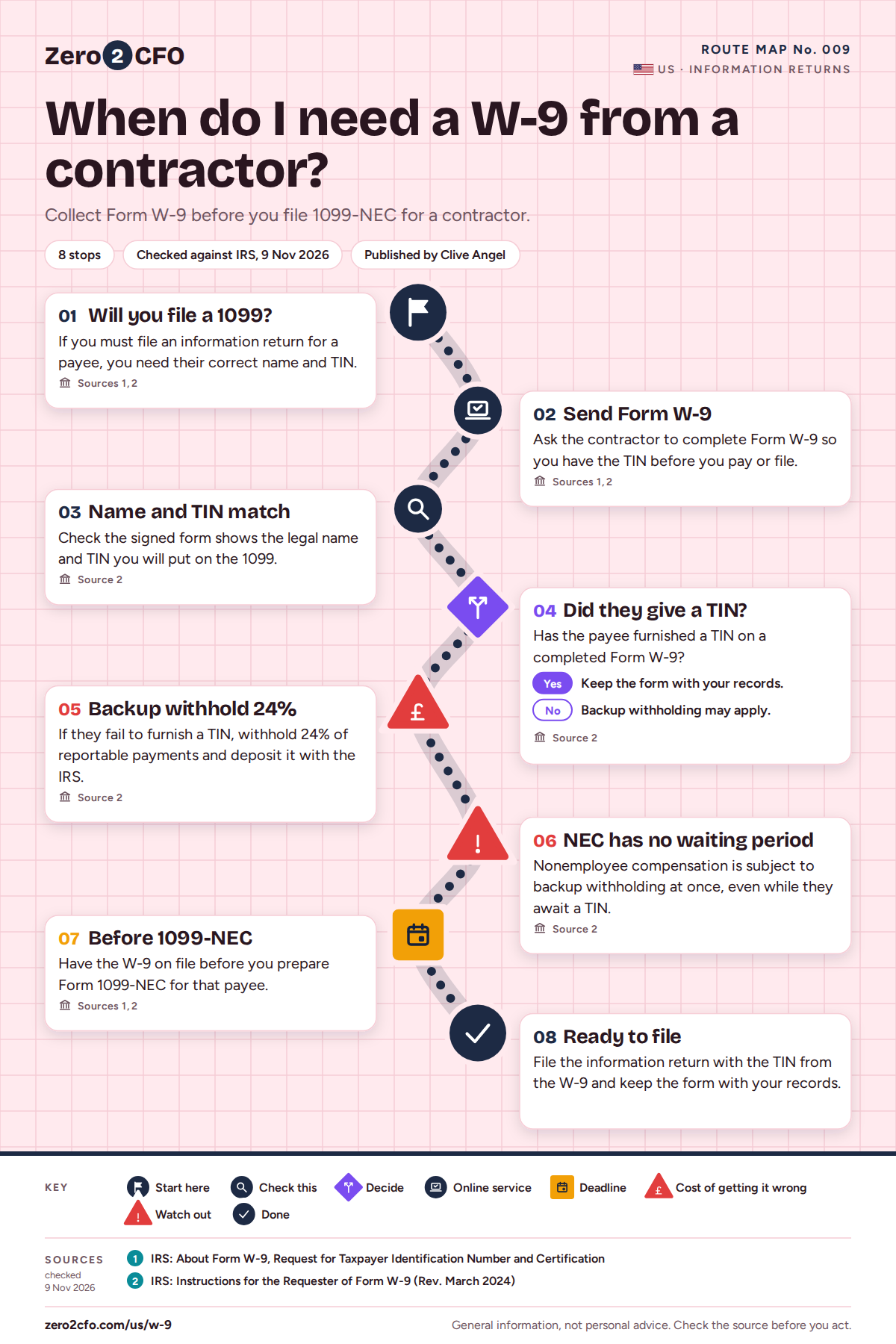
Collect Form W-9 before you file an information return for a contractor. The form gives you their correct name and TIN. This page is general information, not tax advice.
The route, stop by stop
03Name and TIN match
Check the signed form shows the legal name and TIN you will put on the 1099.
Source 2
04Did they give a TIN?
Has the payee furnished a TIN on a completed Form W-9?
YesKeep the form with your records.NoBackup withholding may apply.Source 2
05Backup withhold 24%
If they fail to furnish a TIN, withhold 24% of reportable payments and deposit it with the IRS.
Source 2
06NEC has no waiting period
Nonemployee compensation is subject to backup withholding at once, even while they await a TIN.
Source 2
08Ready to file
File the information return with the TIN from the W-9 and keep the form with your records.
Why you need it
Form W-9 is used by persons required to file information returns with the IRS to get the payee’s correct name and TIN. Use it when you will report income paid to them.
Backup withholding
A properly completed and signed Form W-9 can be relied upon to avoid backup withholding. If a payee fails to furnish a TIN, you must deduct, withhold and deposit 24% of reportable payments until that is fixed.
Nonemployee compensation
Nonemployee compensation is subject to backup withholding immediately, even if the payee has applied for and is awaiting a TIN.
Common questions
When do I ask for the W-9?
Before you pay them, or at least before you prepare Form 1099-NEC.
What if they refuse?
Backup withholding may apply until they furnish a TIN.
Is this tax advice?
No. It is general information from IRS pages checked on 9 November 2026. Rules change, so check the sources before you act.
Where the rules come from
- IRS: About Form W-9, Request for Taxpayer Identification Number and Certification checked 9 November 2026
- IRS: Instructions for the Requester of Form W-9 (Rev. March 2024) checked 9 November 2026
This map is general information, not personal advice. Rules and rates change, so check the sources before you act. If your situation is tricky, talk to your CPA or tax adviser.