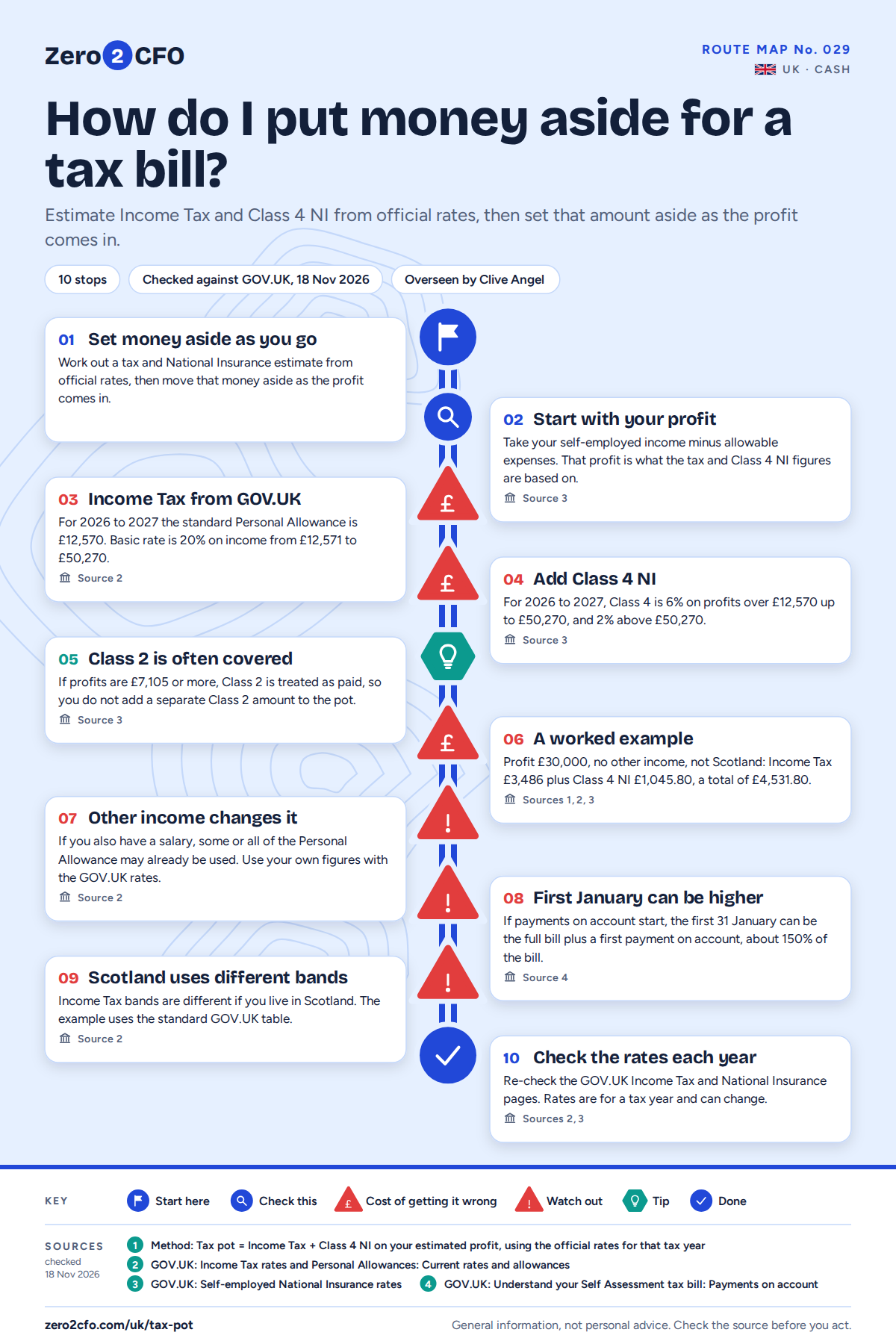
Work out an estimate of Income Tax and Class 4 National Insurance from the official GOV.UK rates, then set that amount aside as the profit comes in. The figures below are for the 2026 to 2027 tax year, in pounds, with a worked example that assumes no other income and is not for Scotland. This page sets out a method using official GOV.UK rates. It is general information, not tax advice.
The route, stop by stop
01Set money aside as you go
Work out a tax and National Insurance estimate from official rates, then move that money aside as the profit comes in.
02Start with your profit
Take your self-employed income minus allowable expenses. That profit is what the tax and Class 4 NI figures are based on.
Source 3
03Income Tax from GOV.UK
For 2026 to 2027 the standard Personal Allowance is £12,570. Basic rate is 20% on income from £12,571 to £50,270.
Source 2
04Add Class 4 NI
For 2026 to 2027, Class 4 is 6% on profits over £12,570 up to £50,270, and 2% above £50,270.
Source 3
05Class 2 is often covered
If profits are £7,105 or more, Class 2 is treated as paid, so you do not add a separate Class 2 amount to the pot.
Source 3
07Other income changes it
If you also have a salary, some or all of the Personal Allowance may already be used. Use your own figures with the GOV.UK rates.
Source 2
08First January can be higher
If payments on account start, the first 31 January can be the full bill plus a first payment on account, about 150% of the bill.
Source 4
09Scotland uses different bands
Income Tax bands are different if you live in Scotland. The example uses the standard GOV.UK table.
Source 2
The method
Start with your self-employed income minus allowable expenses. That profit is what Income Tax and Class 4 National Insurance are based on.
For 2026 to 2027, the standard Personal Allowance is £12,570. In the standard GOV.UK table, basic rate is 20% on taxable income from £12,571 to £50,270, higher rate is 40% from £50,271 to £125,140, and additional rate is 45% over £125,140. Income Tax bands are different if you live in Scotland.
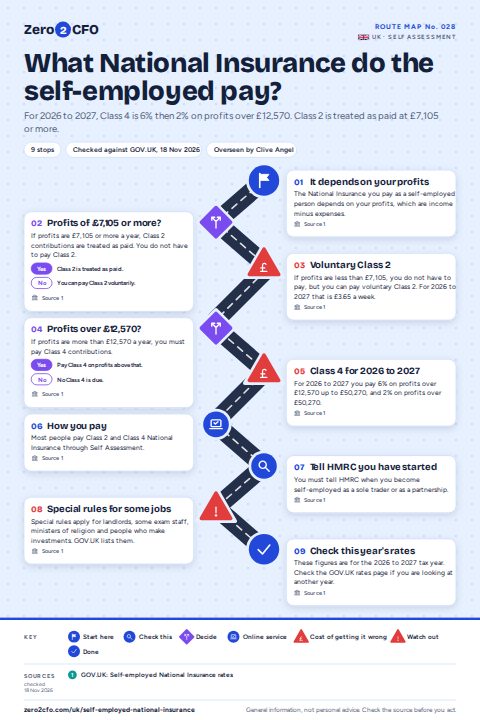
Then add Class 4 National Insurance. For 2026 to 2027 that is 6% on profits over £12,570 up to £50,270, and 2% on profits over £50,270. If profits are £7,105 or more, Class 2 is treated as paid, so you do not add a separate Class 2 amount.
If you also have a salary or other taxable income, some or all of the Personal Allowance may already be used. Use your own figures with the same official rates.
Worked example
Tax year 2026 to 2027. Profit after expenses is £30,000. No other income, and not in Scotland.
The Personal Allowance of £12,570 leaves £17,430. Income Tax at 20% is £3,486. Class 4 NI at 6% on £17,430 is £1,045.80. The total to set aside for that year is £4,531.80. Across 12 months that is £377.65 a month.
Payments on account
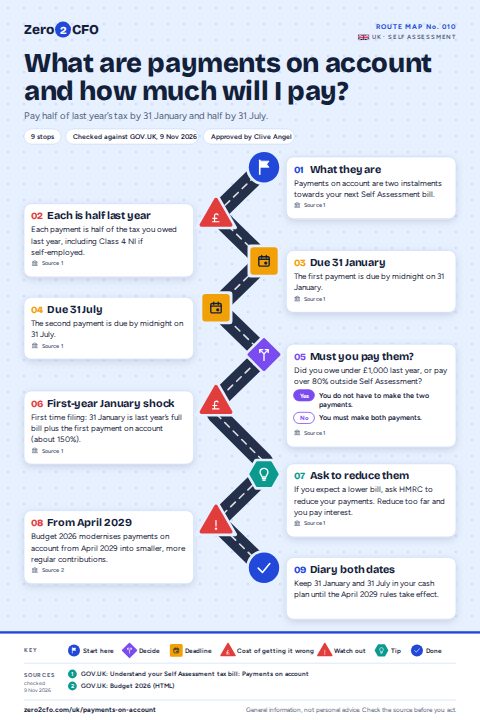
Payments on account are two instalments towards your next Self Assessment bill, including Class 4 National Insurance if you are self-employed. Each payment is half of the tax you owed last year, due by midnight on 31 January and 31 July, unless the tax you owed last year was less than £1,000, or you paid more than 80% of it outside Self Assessment.
If you did not make payments on account last year, for example because it is your first time filing Self Assessment, GOV.UK says you need to pay both the full amount of your tax calculation and your first payment on account towards the next bill. In GOV.UK's example, a £3,000 bill means £4,500 to pay on 31 January, which is the bill plus half again.
Using the worked example, if payments on account also applied, the first 31 January would be £4,531.80 plus a first payment on account of £2,265.90, a total of £6,797.70. The second payment on account would then be due by 31 July.
Common questions
Is this a 25% rule?
No. The method uses the official Income Tax and Class 4 rates for the tax year, applied to your own profit and other income. A flat percentage can undershoot or overshoot.
What if I live in Scotland?
Income Tax bands are different if you live in Scotland. Use the Scottish rates with the same method, and the same Class 4 National Insurance figures, which are set on the self-employed NI page.
What if I also have a PAYE salary?
The Personal Allowance may already be used, in whole or in part, against that income. Use your own figures with the GOV.UK rates rather than the no-other-income example.
Is this tax advice?
No. It is a method using official 2026 to 2027 rates from GOV.UK pages checked on 18 November 2026. It does not tell you how much to set aside in your case. Rates change, so check the sources before you act.
Where the rules and methods come from
- How it's worked out: Tax pot = Income Tax + Class 4 NI on your estimated profit, using the official rates for that tax year
Worked example: Tax year 2026 to 2027, profit £30,000 after expenses, no other income, not Scotland. Personal Allowance £12,570 leaves £17,430. Income Tax at 20% is £3,486. Class 4 NI at 6% on £17,430 is £1,045.80. Total to set aside: £4,531.80. Across 12 months that is £377.65 a month. If payments on account also apply, the first 31 January can also include the first payment on account, which is half of that bill. - GOV.UK: Income Tax rates and Personal Allowances: Current rates and allowances checked 18 November 2026
- GOV.UK: Self-employed National Insurance rates checked 18 November 2026
- GOV.UK: Understand your Self Assessment tax bill: Payments on account checked 18 November 2026
This map is general information, not personal advice. Rules and rates change, so check the sources before you act. If your situation is tricky, talk to your accountant.
Franchise networks can share this Route Map with their franchisees under their own name. See all the Route Maps for new UK franchisees.