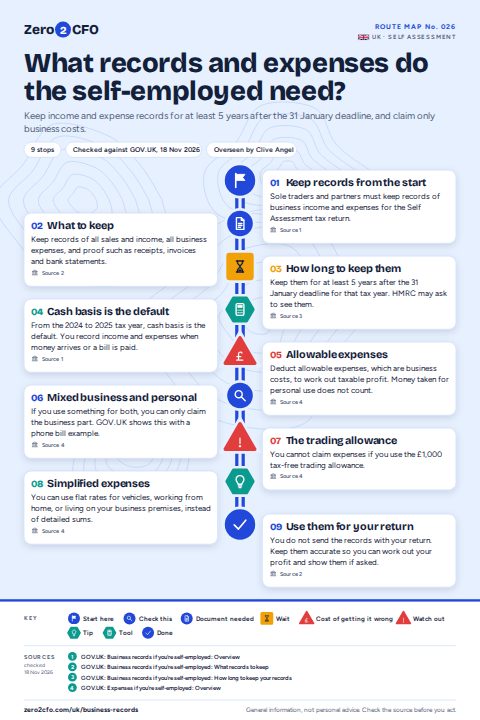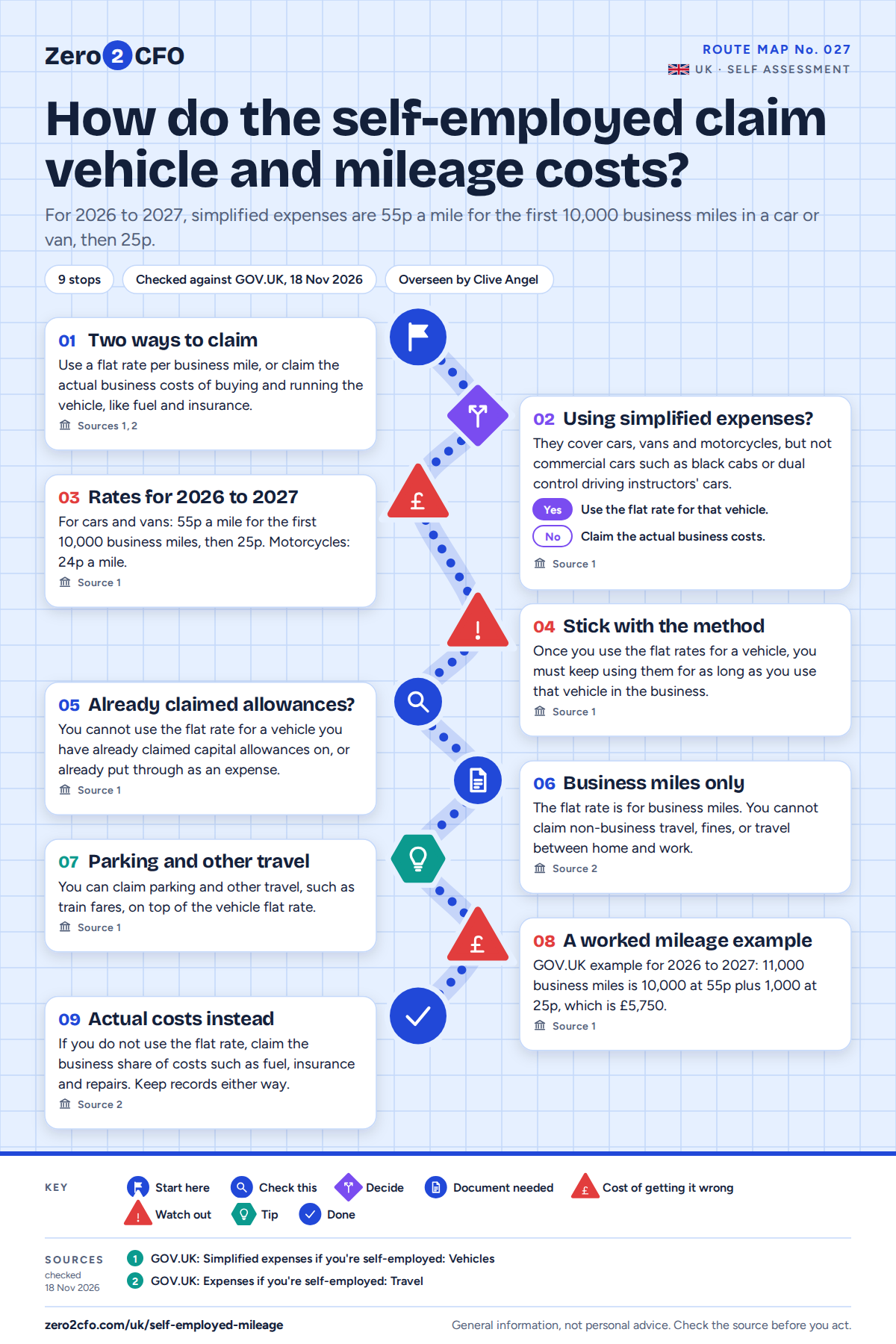
If you are self-employed, you can claim vehicle costs either as a flat rate per business mile, known as simplified expenses, or as the actual business costs of buying and running the vehicle. For the 2026 to 2027 tax year the flat rate for cars and vans is 55p a mile for the first 10,000 business miles, then 25p. This page is general information from GOV.UK, not tax advice.
The route, stop by stop
02Using simplified expenses?
They cover cars, vans and motorcycles, but not commercial cars such as black cabs or dual control driving instructors' cars.
YesUse the flat rate for that vehicle.NoClaim the actual business costs.Source 1
03Rates for 2026 to 2027
For cars and vans: 55p a mile for the first 10,000 business miles, then 25p. Motorcycles: 24p a mile.
Source 1
04Stick with the method
Once you use the flat rates for a vehicle, you must keep using them for as long as you use that vehicle in the business.
Source 1
05Already claimed allowances?
You cannot use the flat rate for a vehicle you have already claimed capital allowances on, or already put through as an expense.
Source 1
06Business miles only
The flat rate is for business miles. You cannot claim non-business travel, fines, or travel between home and work.
Source 2
07Parking and other travel
You can claim parking and other travel, such as train fares, on top of the vehicle flat rate.
Source 1
08A worked mileage example
GOV.UK example for 2026 to 2027: 11,000 business miles is 10,000 at 55p plus 1,000 at 25p, which is £5,750.
Source 1
09Actual costs instead
If you do not use the flat rate, claim the business share of costs such as fuel, insurance and repairs. Keep records either way.
Source 2
Simplified expenses for 2026 to 2027
The flat rate stands in for the actual costs of buying and running the vehicle, such as insurance, repairs, servicing and fuel. You can use it for cars, goods vehicles such as vans, and motorcycles. You cannot use it for some cars designed for commercial use, for example black cabs, hackney carriages or dual control driving instructors' cars.
| Vehicle | First 10,000 business miles | After 10,000 miles |
|---|---|---|
| Cars and goods vehicles, 2026 to 2027 | 55p | 25p |
| Cars and goods vehicles, before 6 April 2026 | 45p | 25p |
| Motorcycles, both periods | 24p | 24p |
GOV.UK's example for 2026 to 2027: 11,000 business miles is 10,000 at 55p, which is £5,500, plus 1,000 at 25p, which is £250, a total of £5,750.
You do not have to use flat rates for every vehicle. Once you use them for a vehicle, you must continue to do so for as long as you use that vehicle in the business. You cannot use simplified expenses for a vehicle you have already claimed capital allowances for, or already included as an expense when you worked out your profits.
You can claim other travel, such as train fares, and parking on top of the vehicle flat rate.
Actual costs
If you do not use the flat rate, you can claim allowable business expenses such as vehicle insurance, repairs and servicing, fuel, parking, hire charges, vehicle tax, breakdown cover, and other travel such as train, bus, tram, air and taxi fares. Hotel rooms and meals on overnight business trips can also be allowable.
You cannot claim non-business driving or travel costs, fines or penalty charges, or travel between home and work.
If you use traditional accounting and buy a vehicle for the business, you can claim capital allowances on the cost. If you use cash basis and buy a car, you claim capital allowances on the cost as long as you are not using simplified expenses. For other types of vehicle under cash basis, claim the cost as an allowable expense.
Common questions
Is the rate still 45p a mile?
Not for the 2026 to 2027 tax year. The first 10,000 business miles in a car or van are 55p from 6 April 2026. The 45p rate is the figure GOV.UK gives for miles before that date.
Can I switch from the flat rate to actual costs on the same car?
Not while you still use that vehicle in the business. Once you use the flat rates for a vehicle, you must continue to do so for as long as you use it for your business.
Can I claim parking as well as mileage?
Yes. GOV.UK says you can claim parking and other travel, such as train journeys, on top of your vehicle expenses.
Can I claim the drive from home to work?
No. GOV.UK says you cannot claim travel between home and work, or non-business driving, or fines.
Is this tax advice?
No. It is general information from GOV.UK pages checked on 18 November 2026. It does not tell you which method to use in your case. Rules change, so check the sources before you act.
Where the rules come from
- GOV.UK: Simplified expenses if you're self-employed: Vehicles checked 18 November 2026
- GOV.UK: Expenses if you're self-employed: Travel checked 18 November 2026
This map is general information, not personal advice. Rules and rates change, so check the sources before you act. If your situation is tricky, talk to your accountant.
Franchise networks can share this Route Map with their franchisees under their own name. See all the Route Maps for new UK franchisees.