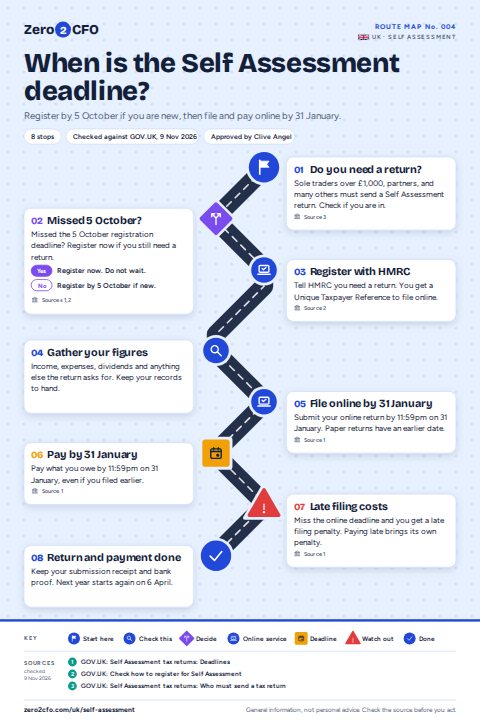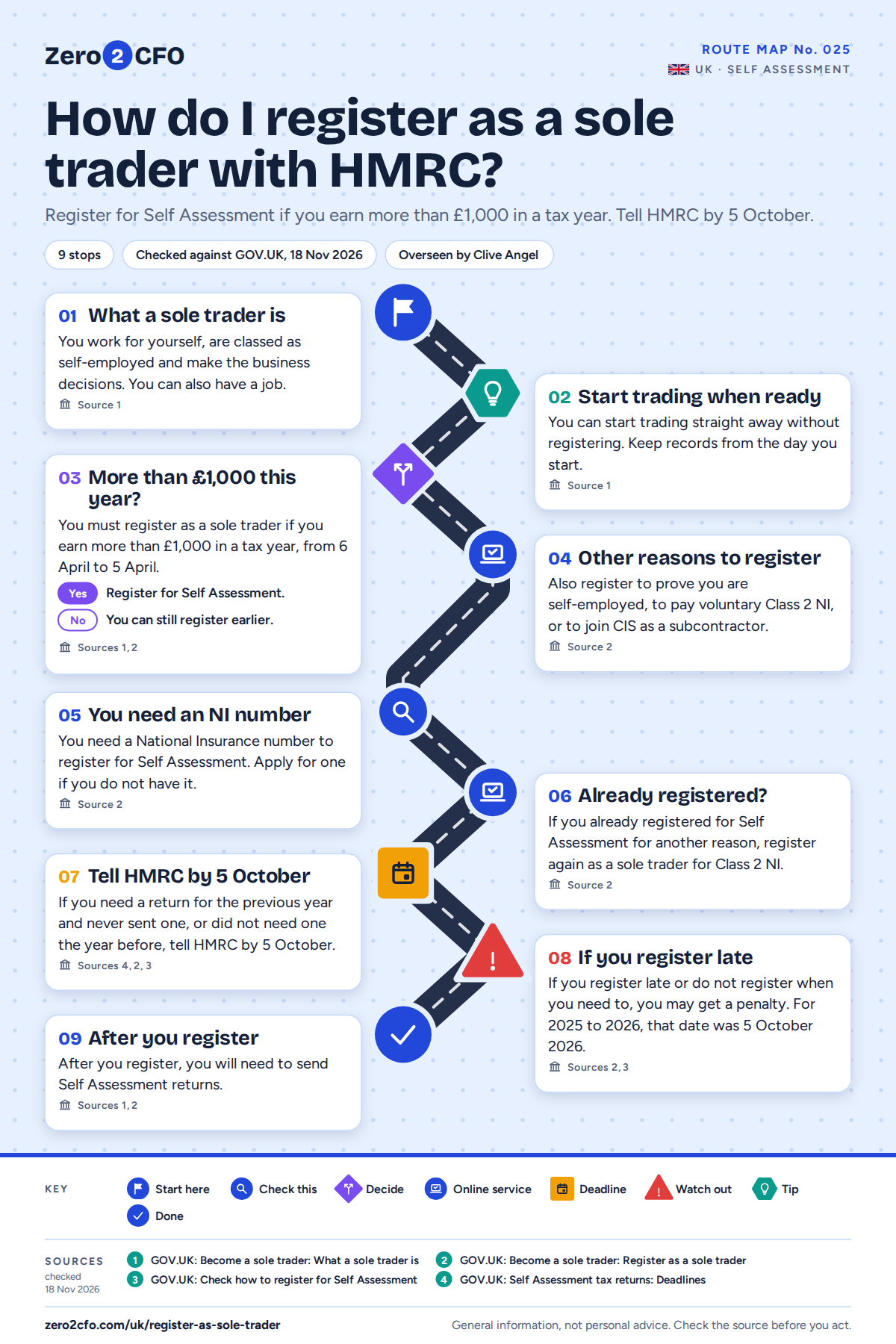
You can start trading as a sole trader without registering first. You must register for Self Assessment if you earn more than £1,000 in a tax year, and you can register earlier. Tell HMRC by 5 October if you need a return for the previous year and have not sent one before. This page is general information from GOV.UK, not tax advice.
The route, stop by stop
01What a sole trader is
You work for yourself, are classed as self-employed and make the business decisions. You can also have a job.
Source 1
02Start trading when ready
You can start trading straight away without registering. Keep records from the day you start.
Source 1
04Other reasons to register
Also register to prove you are self-employed, to pay voluntary Class 2 NI, or to join CIS as a subcontractor.
Source 2
05You need an NI number
You need a National Insurance number to register for Self Assessment. Apply for one if you do not have it.
Source 2
06Already registered?
If you already registered for Self Assessment for another reason, register again as a sole trader for Class 2 NI.
Source 2
What a sole trader is
A sole trader is the simplest business structure. You work for yourself, you are classed as self-employed, and you make the business decisions. You can do this as your only work, or be employed and self-employed at the same time.
When you must register
You register as a sole trader by registering for Self Assessment with HMRC. You can start trading straight away without registering. You must register if you earn more than £1,000 in a tax year, which runs from 6 April to 5 April. You can choose to register earlier.
GOV.UK also says you must register if you need to prove you are self-employed, for example to claim Tax-Free Childcare, if you want to make voluntary Class 2 National Insurance payments, or if you need to register as a subcontractor for the Construction Industry Scheme or as a share fisher.
You need a National Insurance number to register. If you have already registered for Self Assessment for another reason, you need to register again as a sole trader so that you are registered for Class 2 National Insurance.
When you start trading you must keep records. After you have registered you will need to submit Self Assessment tax returns.
The 5 October date
GOV.UK says you must tell HMRC by 5 October if you need to complete a tax return for the previous year and you have either not sent a tax return before, or you registered before but did not need to send a tax return for the year before that. You tell HMRC by registering for Self Assessment.
For a return for the 2025 to 2026 tax year, which ran from 6 April 2025 to 5 April 2026, GOV.UK gives that date as 5 October 2026. If you tell HMRC after 5 October 2026, you could get a penalty. HMRC will send you a letter or email with a different deadline to send your tax return by, which will be 3 months from the date on the letter or email. You must still pay the tax you owe by 11:59pm on 31 January 2027.
Common questions
Can I start trading before I register?
Yes. GOV.UK says you can start trading straight away without registering. Keep records from the day you start, and register once you need to, or earlier if you choose.
What if I also have a job?
You can be employed and self-employed at the same time. You still register as a sole trader if the tests on GOV.UK are met.
What if I missed 5 October 2026?
Register now. You may get a penalty. HMRC will give you a filing deadline 3 months from the date of its letter or email. Payment is still due by 11:59pm on 31 January 2027.
I already send a Self Assessment return. Do I register again?
Yes, if you have already registered for another reason. GOV.UK says you need to register again as a sole trader so that you are registered for Class 2 National Insurance.
Is this tax advice?
No. It is general information from GOV.UK pages checked on 18 November 2026. It does not tell you whether you must register in your case. Rules change, so check the sources before you act.
Where the rules come from
- GOV.UK: Become a sole trader: What a sole trader is checked 18 November 2026
- GOV.UK: Become a sole trader: Register as a sole trader checked 18 November 2026
- GOV.UK: Check how to register for Self Assessment checked 18 November 2026
- GOV.UK: Self Assessment tax returns: Deadlines checked 18 November 2026
This map is general information, not personal advice. Rules and rates change, so check the sources before you act. If your situation is tricky, talk to your accountant.
Franchise networks can share this Route Map with their franchisees under their own name. See all the Route Maps for new UK franchisees.