If you are a sole trader or a partner, you must keep records of your business income and expenses for your Self Assessment tax return. You can deduct allowable expenses, which are business costs, to work out your taxable profit. Keep the records for at least 5 years after the 31 January deadline. This page is general information from GOV.UK, not tax advice.
The route, stop by stop
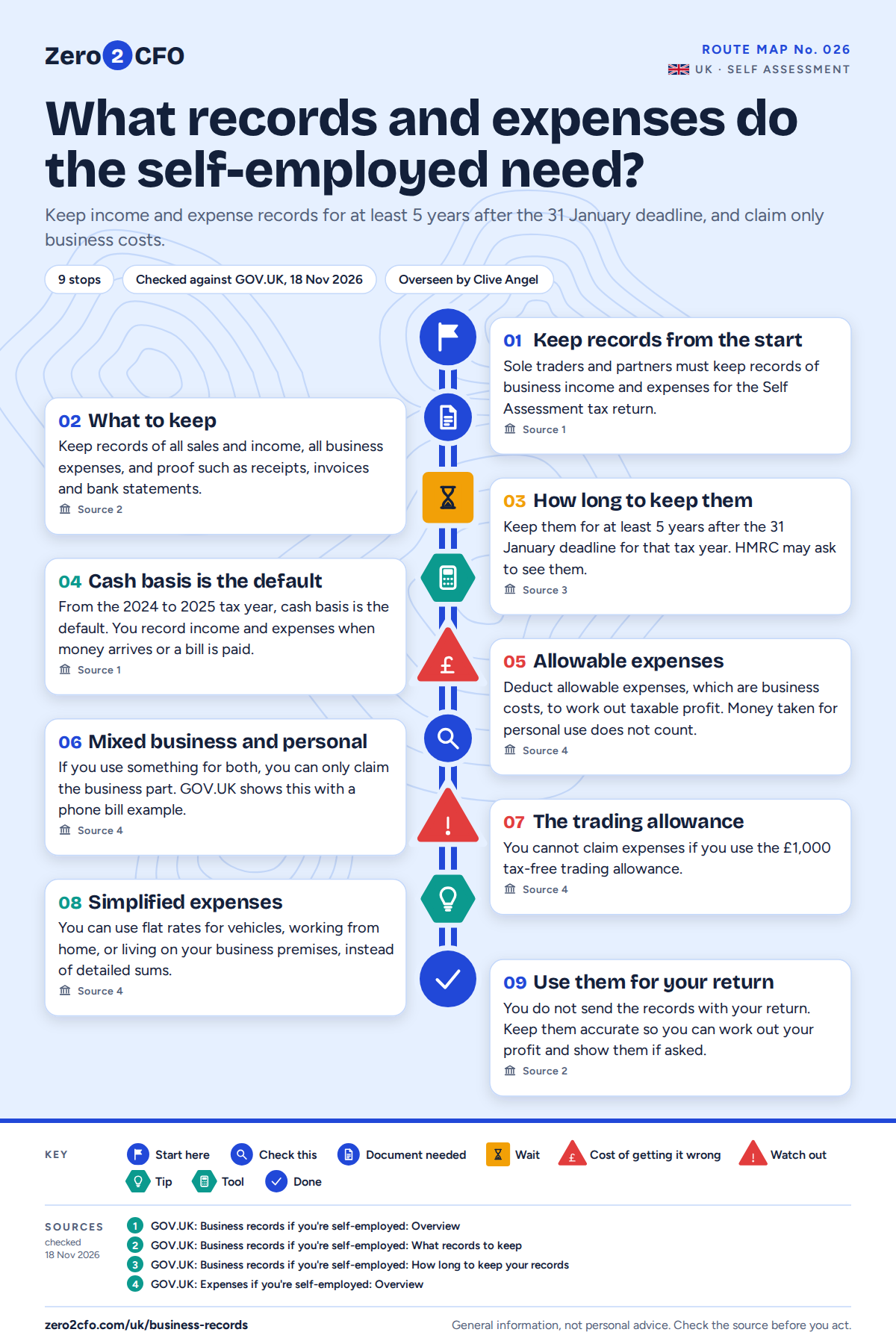
01Keep records from the start
Sole traders and partners must keep records of business income and expenses for the Self Assessment tax return.
Source 1
02What to keep
Keep records of all sales and income, all business expenses, and proof such as receipts, invoices and bank statements.
Source 2
03How long to keep them
Keep them for at least 5 years after the 31 January deadline for that tax year. HMRC may ask to see them.
Source 3
04Cash basis is the default
From the 2024 to 2025 tax year, cash basis is the default. You record income and expenses when money arrives or a bill is paid.
Source 1
05Allowable expenses
Deduct allowable expenses, which are business costs, to work out taxable profit. Money taken for personal use does not count.
Source 4
06Mixed business and personal
If you use something for both, you can only claim the business part. GOV.UK shows this with a phone bill example.
Source 4
07The trading allowance
You cannot claim expenses if you use the £1,000 tax-free trading allowance.
Source 4
08Simplified expenses
You can use flat rates for vehicles, working from home, or living on your business premises, instead of detailed sums.
Source 4
09Use them for your return
You do not send the records with your return. Keep them accurate so you can work out your profit and show them if asked.
Source 2
What to keep
GOV.UK says you need records of all sales and income, all business expenses, VAT records if you are registered for VAT, PAYE records if you employ people, and records of your personal income. Proof includes receipts, bank statements, sales invoices, till rolls and bank slips. Your records must be accurate, and you must be able to identify business transactions.
You do not send the records in with your tax return. You keep them so you can work out your profit or loss, and show them to HMRC if asked.
How long to keep them
You must keep your records for at least 5 years after the 31 January submission deadline of the relevant tax year. GOV.UK gives this example: if you sent your 2022 to 2023 tax return online by 31 January 2024, you must keep those records until at least the end of January 2029. If you send a return more than 4 years after the deadline, you need to keep the records for 15 months after you send it.
Cash basis
From the 2024 to 2025 tax year, cash basis is the default method of accounting. You record income or expenses when you receive money or pay a bill, so you do not pay Income Tax on money you have not yet received. You must opt out if you want to use traditional accounting, or if you cannot use cash basis.
If you do not prepare accounts, record your income and expenses for each tax year, from 6 April to 5 April.
Allowable expenses
You can deduct allowable expenses to work out your taxable profit. GOV.UK gives this example: turnover of £40,000 and allowable expenses of £10,000 leaves a taxable profit of £30,000. Allowable expenses do not include money taken from the business for personal use.
If you use something for both business and personal reasons, you can only claim the business costs. You cannot claim expenses if you use the £1,000 tax-free trading allowance.
You can use simplified expenses, which are flat rates, for vehicles, working from home, or living on your business premises.
This map is for sole traders and individual partners. If you run a limited company you are not self-employed for these rules, even if you are the owner and only employee.
Common questions
Do I send receipts to HMRC with my return?
No. You do not need to send your records in when you submit your tax return. Keep them, and show them if HMRC asks.
Can I claim the full cost of a phone I also use at home?
Only the business part. GOV.UK's example splits a £200 phone bill into £70 of business calls, which is the amount you can claim, and £130 of personal calls, which you cannot.
What if I use the £1,000 trading allowance?
You cannot claim expenses if you use it.
Is this tax advice?
No. It is general information from GOV.UK pages checked on 18 November 2026. It does not tell you which costs you can claim in your case. Rules change, so check the sources before you act.
Where the rules come from
- GOV.UK: Business records if you're self-employed: Overview checked 18 November 2026
- GOV.UK: Business records if you're self-employed: What records to keep checked 18 November 2026
- GOV.UK: Business records if you're self-employed: How long to keep your records checked 18 November 2026
- GOV.UK: Expenses if you're self-employed: Overview checked 18 November 2026
This map is general information, not personal advice. Rules and rates change, so check the sources before you act. If your situation is tricky, talk to your accountant.
Franchise networks can share this Route Map with their franchisees under their own name. See all the Route Maps for new UK franchisees.